
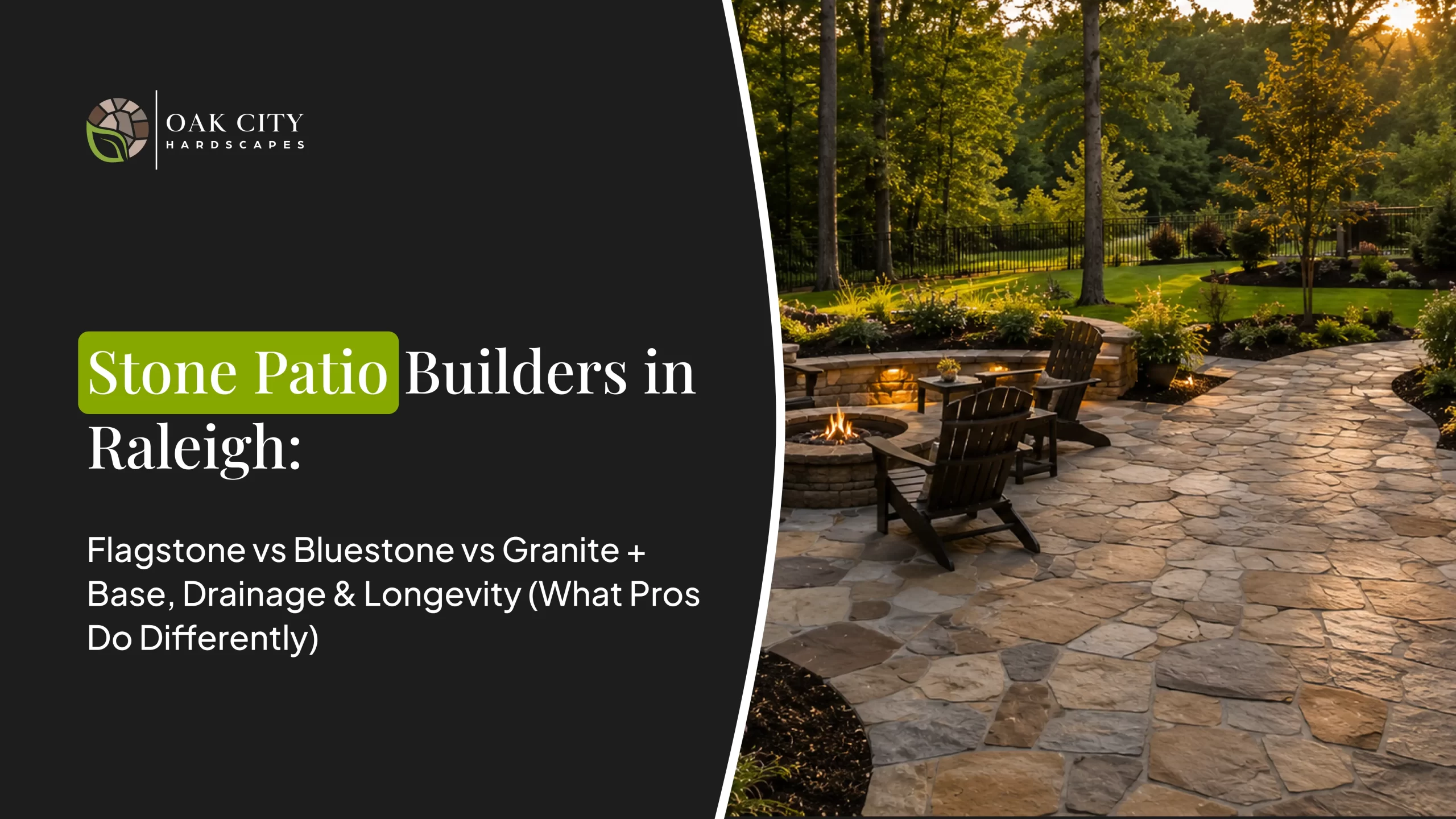
If you’ve started pricing out a stone patio in Raleigh, you’ve probably noticed that every contractor talks about “natural stone” as if it’s one product. It isn’t. Flagstone, bluestone, and granite behave differently in our clay soil and humid summers, and the base underneath matters more than the stone on top. Here’s what actually separates a patio that lasts twenty years from one that heaves and cracks in five.
Flagstone vs Bluestone vs Granite: What’s the Real Difference
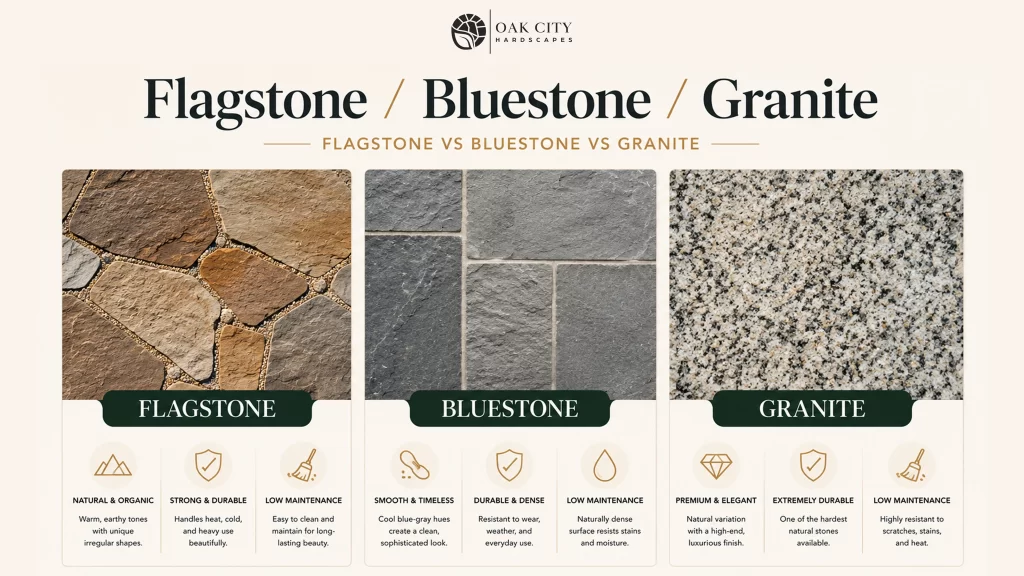
Flagstone is irregular-shaped natural stone, usually sandstone or quartzite, with a textured surface and earthy color range. It’s the most budget-friendly of the three and gives a casual, organic look that suits wooded Raleigh lots.
Bluestone is a sedimentary stone with a tighter grain and a clean blue-gray to slate color. It comes in regular-cut shapes (great for a more formal layout) or in irregular pieces. Bluestone holds up well in freeze-thaw cycles, which matters during Raleigh’s occasional ice events.
Granite is the densest and most durable of the three. It resists staining, scratching, and weathering better than flagstone or bluestone, but it’s also the priciest and heaviest, which affects labor and base requirements.
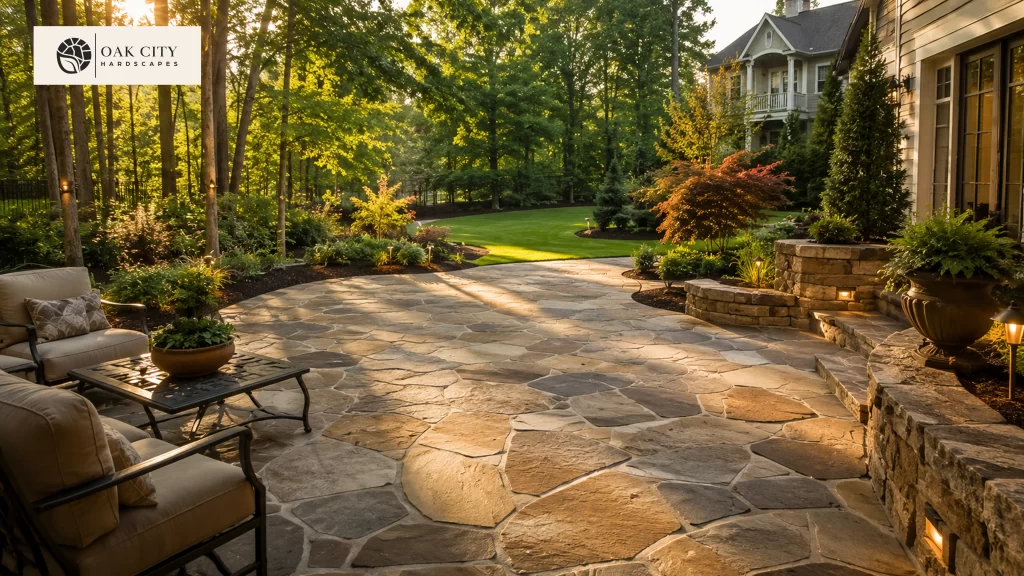
For most Raleigh patios, the choice comes down to three things: budget, your home’s style, and how much foot traffic the space gets. A flagstone patio under a pergola for morning coffee has different demands than a granite patio surrounding an outdoor kitchen.
Why Raleigh’s Clay Soil Changes the Whole Equation
The Triangle sits on heavy clay soil that expands when wet and contracts when dry. If a patio is installed without accounting for this movement, you’ll see settling, shifting joints, and stones that rock underfoot within a couple of seasons.
This is one of the biggest gaps between a patio that’s “installed” and one that’s “built.” A contractor who’s worked clay soil in Apex, Cary, or Garner knows to dig deeper, compact in lifts, and choose a base material that drains rather than holds water against the clay.
The Base Most Homeowners Never See (and Why It’s the Part That Matters)
Here’s the part nobody asks about during the sales pitch, but it’s the part that determines whether your patio is still flat in 2036.
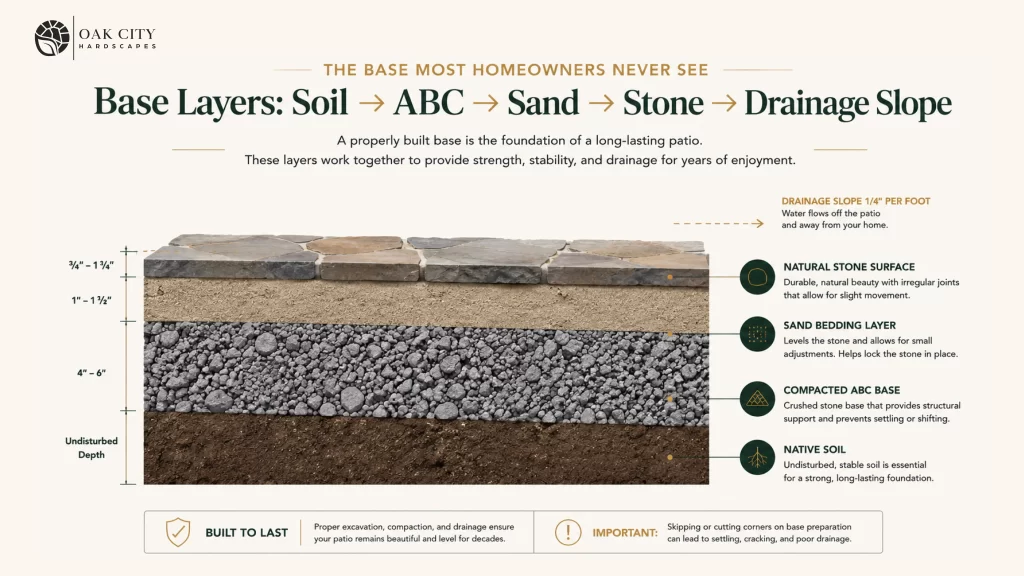
A proper base for a stone patio in Raleigh typically means:
- Excavation 8 to 10 inches deep, depending on stone thickness
- A compacted layer of crushed stone (often called ABC, or aggregate base course), placed and compacted in 2 to 3-inch lifts
- A bedding layer of coarse sand or stone dust, screeded flat
- Edge restraints to keep the perimeter from spreading over time
Skipping compaction in lifts, or using fill dirt instead of crushed stone, is the single most common shortcut that leads to a patio that looks great at handoff and uneven within two years. If a quote seems unusually low, ask specifically what’s going on under the stone and how it’s compacted.
Drainage Mistakes That Show Up Two Years Later
Raleigh gets heavy, fast rainfall, and a patio with no slope or drainage plan will hold water against your foundation, erode the base from underneath, or create standing puddles that stain the stone.
Common issues include:
- Patios sloped toward the house instead of away from it
- No gap or drainage channel where the patio meets a deck or siding
- Joints filled with polymeric sand that wasn’t installed correctly, trapping water under the stone
A good rule of thumb is a slope of about 1/4 inch per foot away from the home. If your contractor can’t tell you the slope and where the water goes, that’s worth asking about before signing anything.
How Much Does a 20×20 Stone Patio Cost in Raleigh
A 20×20 stone patio (400 square feet) in the Raleigh area generally falls between $9,000 and $20,000, depending on the stone choice, the base depth required for your soil, and the design complexity (curves, multiple levels, fire pit integration).
Flagstone patios tend to land on the lower end of that range. Granite, with its higher material cost and additional labor required to handle heavier stone, falls on the higher end. Bluestone sits in the middle, with cut bluestone costing more than irregular bluestone.
Keep in mind that quotes that don’t separate out base prep, drainage work, and stone installation can be hard to compare. Ask for a breakdown so you can compare apples to apples across contractors.
Stone Patio vs Deck: Which Makes Sense for Your Yard
This comes up often for homeowners weighing their options before committing. A stone patio sits at grade, typically doesn’t require railings, and suits flatter yards or spaces near the home’s foundation level. A deck, especially a composite deck built with TimberTech, makes more sense for sloped lots, elevated entries, or when you want separation from ground moisture.
Some homeowners end up doing both: a deck off the back door, transitioning to a stone patio at ground level for a fire pit or seating area. If you’re not sure which fits your lot, that’s exactly the kind of question worth raising during a consultation.
The Oak City Advantage for Stone Patios in Raleigh
If you’re comparing stone patio builders in Raleigh, the build quality lives almost entirely in the parts you can’t see once it’s finished. Oak City Hardscapes is owner-led by Max Laing and Grayson Boyd, who are personally on site for every project, ensuring the excavation depth, base compaction, and drainage slope are checked by the people who founded the company to get this right the first time.
Oak City’s patio design and installation services cover flagstone, bluestone, and granite, with base and drainage work specced for Raleigh’s clay soil rather than a generic national template. For homeowners weighing a patio against a deck, the outdoor living spaces page shows how patios pair with fire pits, retaining walls, and pergolas for a full backyard build. And if drainage near your home’s foundation is a concern, Oak City’s retaining wall and grading work addresses water management as part of the same project, not as an afterthought.
Every Oak City project starts with architectural drawings before any contract is signed, and permits and inspections are handled in-house, with every inspection passed on the first try across their completed Triangle-area projects.
A stone patio is a project you’ll live with for decades, and the choices made before the first stone goes down (soil prep, base depth, drainage slope) decide how it ages. Whether you go with flagstone, bluestone, or granite, ask your contractor to walk you through the base and drainage plan specifically, not just the stone options. If you want that conversation with a team that’s done this across Raleigh, Cary, and Apex, book a free consultation with Oak City Hardscapes.
FAQs
Q: How much does a 20×20 stone patio cost in Raleigh?
A 20×20 (400 sq ft) stone patio typically runs $9,000 to $20,000 in the Raleigh area, depending on stone type, base depth, and design complexity.
Q: Is a stone patio cheaper than concrete?
Poured concrete is usually cheaper upfront, but natural stone holds up better over time and doesn’t crack in large visible slabs the way concrete can.
Q: Is it cheaper to build a deck or a stone patio?
It depends on the lot. Flat ground near the home often favors a patio, while sloped or elevated areas often favor a composite deck once grading costs are factored in.
Q: What’s the best time of year to build a patio in Raleigh?
Late fall through early spring is ideal, since the ground is easier to excavate and compact, and you’ll have your patio ready before peak outdoor season.
Q: How heavy is a 24×24 stone slab, and does it affect installation?
Large-format stone, especially granite, can weigh well over 100 pounds per slab, which affects equipment needs and base requirements. This is part of why granite costs more in labor.
Q: Do I need a permit for a stone patio in Raleigh?
It depends on size, height, and whether it’s attached to structures like retaining walls. Oak City handles permit checks and filings for every project.
Q: What’s the most common mistake homeowners make when hiring a patio builder?
Comparing quotes on stone cost alone without asking about base depth, compaction method, and drainage slope, which is where quality and longevity actually come from.
Conclusion:
Choosing between flagstone, bluestone, and granite is only part of the decision. While each material offers its own look, durability, and price point, the long-term performance of your stone patio depends far more on what’s happening underneath it. In Raleigh’s clay-heavy soil, proper excavation, base preparation, compaction, and drainage are what prevent settling, shifting, and costly repairs years down the road.
That’s why experienced stone patio builders focus on more than the surface material. They build with the local environment in mind, ensuring every layer is designed to handle moisture, soil movement, and daily use for decades to come.
At Oak City Hardscapes, every patio is planned from the ground up with detailed design drawings, site-specific drainage considerations, and installation practices tailored to Triangle-area properties. Whether you’re leaning toward the natural character of flagstone, the refined look of bluestone, or the durability of granite, the right build process will make all the difference in how your investment performs over time.
Ready to explore the best stone patio option for your backyard? Schedule a free consultation with Oak City Hardscapes and get expert guidance on design, materials, drainage, and installation before the first stone is ever placed.
Key Takeaways
- Flagstone, bluestone, and granite each handle Raleigh’s climate and budget differently, so match the stone to your space and use case.
- Raleigh’s clay soil requires deeper excavation and proper compaction to prevent settling and shifting.
- A compacted crushed stone base in 2 to 3 inch lifts is the foundation of a long-lasting patio.
- Drainage slope of about 1/4 inch per foot away from the home prevents water damage and erosion.
- A 20×20 stone patio in Raleigh generally costs between $9,000 and $20,000.
- Granite costs more due to weight and labor, while flagstone tends to be the most budget-friendly option.
- Ask contractors for an itemized quote that separates base prep, drainage, and stone installation.
- Patios suit flat, ground-level spaces, while decks often work better for sloped or elevated lots.
- Some yards benefit from combining a deck and a patio to create distinct zones of outdoor living.
- The base and drainage work, not the stone itself, is what determines whether a patio lasts decades.
Ready to plan your stone patio the right way, from the ground up? Book a free consultation with Oak City Hardscapes today.