
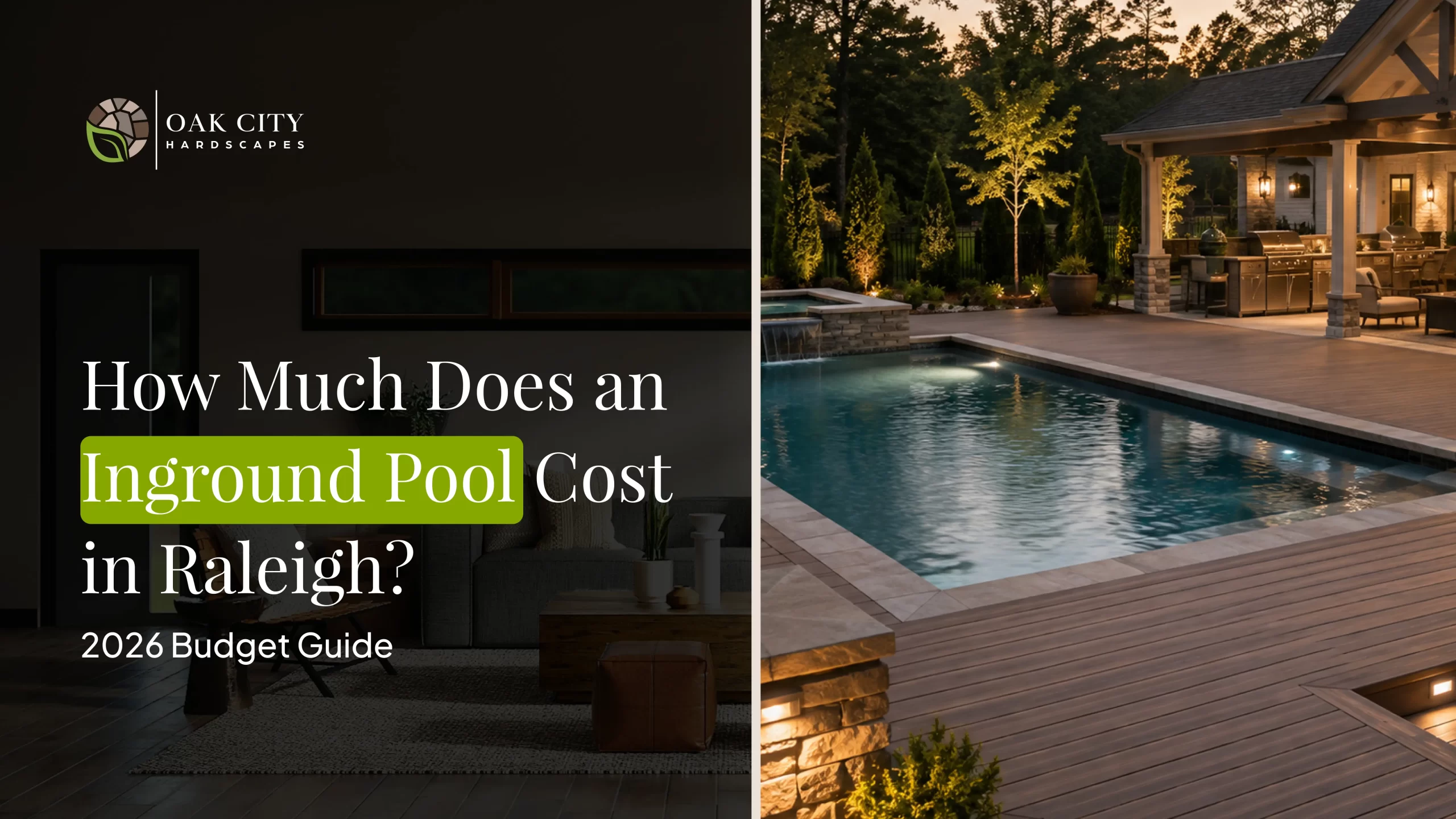
Here is the number no one really wants to say out loud first: the quote on the pool itself is never the number you actually pay.
Every Raleigh homeowner starts this journey the same way. A friend gets a pool. You see the photos. You imagine July afternoons that don’t involve driving to the neighborhood pool club and fighting for a lounge chair. Then you call three contractors, get three wildly different numbers, and realize nobody warned you that “inground pool cost” and “total project cost” are two very different conversations.
This is the guide that has that conversation with you before your contractor does.
Table of Contents
- What Actually Sets Inground Pool Cost in Raleigh
- Fiberglass Pool Cost vs. Gunite Pool Cost: The Real Numbers
- Why Pool Cost Raleigh Homeowners Pay Differs From National Averages
- Site Conditions That Quietly Inflate Your Inground Pool Cost
- The Line Item Everyone Forgets: Decking, Patios, and Drainage
- Permits, HOA Rules, and the Raleigh-Specific Cost Factors
- Financing the Full Project, Not Just the Pool
- Common Mistakes Homeowners Make When Budgeting
- FAQs
- Key Takeaways
What Actually Sets Inground Pool Cost in Raleigh
The inground pool cost you get quoted depends on four things, and most homeowners only ask about one of them: the pool itself.
The real formula is size, material, site conditions, and everything built around the water. Skip any one of those in your budgeting, and you’ll be standing in your backyard in June wondering why the “finished” project still looks unfinished.
In Raleigh, the typical inground pool cost lands somewhere between $45,000 and $95,000 for the pool structure alone. That’s a wide range, and there’s a reason for it. A 12×24 fiberglass shell dropped into flat, easy-access soil is a completely different job than a custom gunite pool cut into a sloped Cary lot with mature trees in the way. Both are technically “inground pools.” Neither costs the same.
Here’s the part that catches people off guard: that $45,000 to $95,000 number almost never includes the deck, the patio, the fencing, or the drainage work that makes the pool actually usable and code-compliant. We’ll get to why that matters, because it’s the single biggest gap between what people budget and what they actually spend.
Fiberglass Pool Cost vs. Gunite Pool Cost: The Real Numbers
This is where the decision actually gets made, so let’s not dance around it.
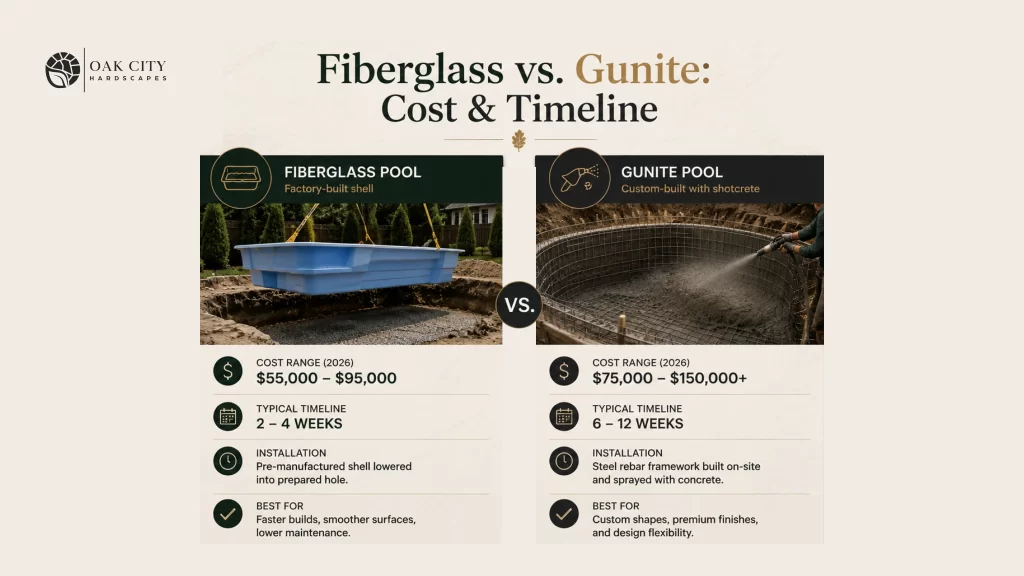
Fiberglass pool cost in the Raleigh area typically runs $45,000 to $65,000 installed. The shell arrives pre-molded, gets craned into an excavated hole, and the install timeline is fast, often 4 to 6 weeks from break ground to water. Fiberglass has a smoother surface, fewer long-term maintenance headaches, and a more predictable price because there’s less labor variability once the shell is on site.
Gunite pool cost runs higher, typically $65,000 to $95,000+ installed, because it’s built differently. Gunite is sprayed concrete over rebar, formed and finished on-site, which means you can build almost any shape, depth, or feature into it. That flexibility is the whole appeal, and it’s also why gunite pool cost climbs the moment you start adding custom edges, tanning ledges, or attached spas.
| Pool Type | Typical Installed Cost | Timeline | Best For |
| Fiberglass | $45,000 to $65,000 | 4 to 6 weeks | Standard shapes, faster install, lower long-term maintenance |
| Gunite/Concrete | $65,000 to $95,000+ | 10 to 16 weeks | Custom shapes, integrated features, long-term durability |
| Vinyl Liner | $35,000 to $55,000 | 6 to 8 weeks | Lower upfront cost, liner replacement every 7 to 10 years |
Notice something? None of these numbers include what happens around the pool. That’s intentional. We’re getting there.
Why Pool Cost Raleigh Homeowners Pay Differs From National Averages
National inground pool cost averages you’ll find online, usually in the $35,000 to $65,000 range, don’t account for what makes Raleigh a specific market rather than a generic one.
Pool cost Raleigh homeowners actually pay tends to run higher than the national midpoint for three reasons. First, Raleigh’s clay-heavy soil is more expensive to excavate and stabilize than sandy or loamy soil found in other parts of the country. Second, labor and material costs in the Triangle have climbed steadily as the region has grown, and pool contractors are booked out further than they were even two years ago. Third, most Raleigh lots weren’t graded with a pool in mind, which means drainage and grading work get added to nearly every project.
None of this is meant to scare you off. It’s meant to make sure the number in your head matches the number on your contract. Pool cost Raleigh contractors quote you should already reflect these local realities, and if a quote comes in dramatically under what we’re describing here, that’s worth asking hard questions about.
Site Conditions That Quietly Inflate Your Inground Pool Cost
Every backyard tells the excavator a different story, and that story changes your inground pool cost before a single brick gets laid.
Slope and grade. A sloped lot, common in neighborhoods like Hedingham or North Raleigh, requires retaining walls or extensive regrading to create a level pool area. This alone can add $8,000 to $20,000.
Access. If equipment can’t get a straight shot to the backyard, crews may need to hand-dig sections or bring in smaller machinery, which slows the job and raises labor costs.
Trees and roots. Removing mature trees, or working around root systems that could interfere with the excavation, adds cost and sometimes delays permitting.
Utility lines. Underground utilities need to be located and sometimes rerouted before excavation begins, another step that rarely makes it into an initial verbal estimate.
This is the part of inground pool cost that’s hardest to estimate over the phone, and it’s exactly why a proper site visit before you sign anything isn’t optional. It’s protection.
If your lot needs regrading or a retaining wall to make the pool area level, it helps to understand a realistic deck and hardscape build timeline before you lock in a completion date with your pool contractor. Site work has a way of pushing every downstream schedule.
The Line Item Everyone Forgets: Decking, Patios, and Drainage
Here’s the twist most people don’t see coming until they’re already three weeks into construction.
You budgeted for the pool. You did not budget for the ten feet of usable space around it.
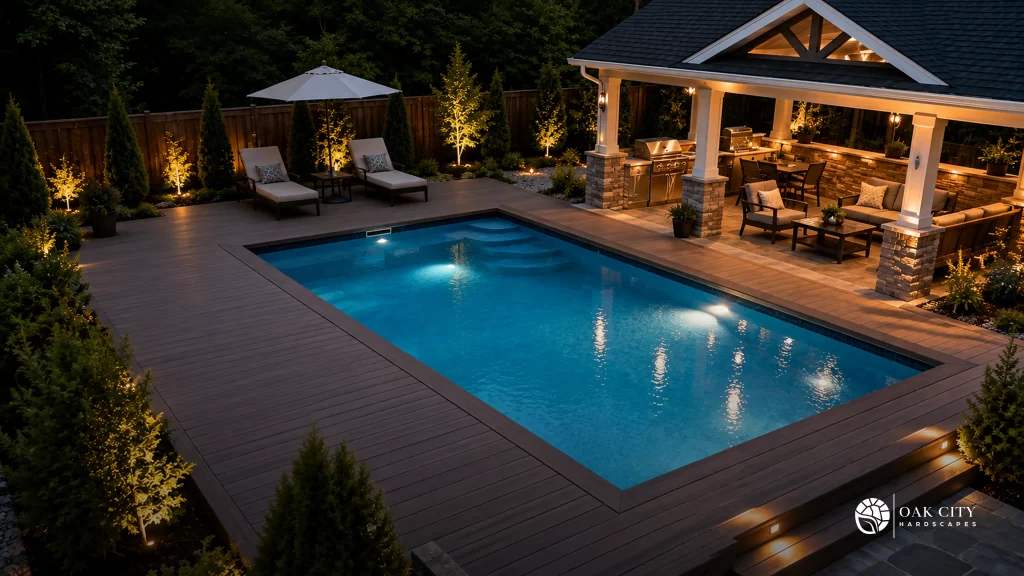
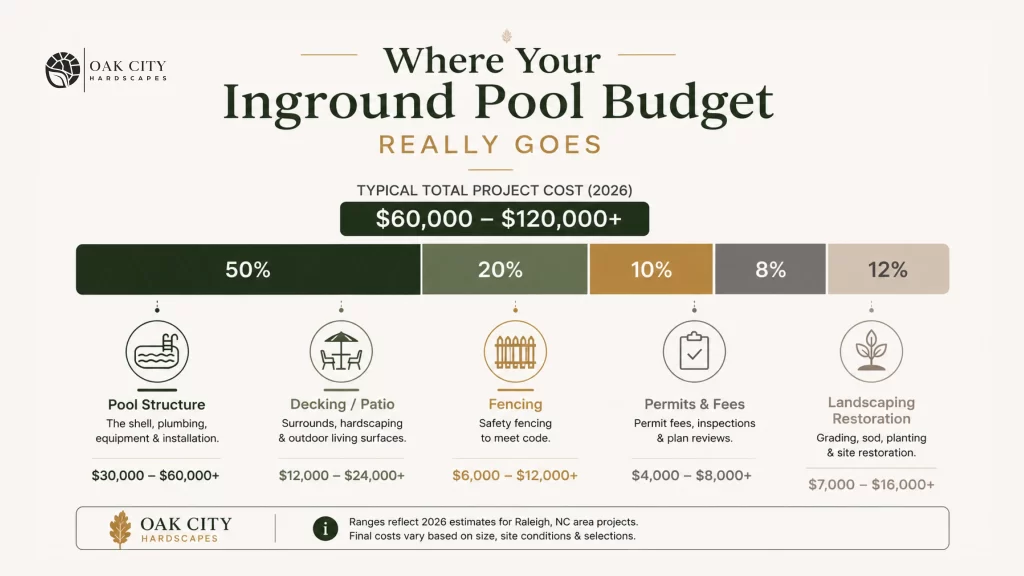
A pool without proper decking is a hole in the ground with water in it and mud around the edges. The decking, patio, and drainage work around a pool typically adds $15,000 to $40,000 depending on materials, square footage, and grading needs. Composite decking, natural stone, or stamped concrete pool surrounds all carry different price points, and drainage has to be engineered correctly or you’ll be dealing with standing water and erosion within the first heavy Raleigh rainstorm.
This is also where the story gets personal for us. We don’t pour the pool shell, but we build the space that makes it a backyard instead of a construction site: the patios, the composite decking, the fire pits, the retaining walls that hold the whole layout together. It’s the part of the project that determines whether your pool actually gets used, or whether it becomes the expensive thing you walk past on the way to the grill.
Material choice matters more around a pool than almost anywhere else on your property, since the surface is exposed to constant splash-out and humidity. Homeowners comparing wood decking against composite for how long it actually lasts usually land on composite once they factor in moisture exposure. If you’re weighing brands, the difference between Trex and TimberTech in hot, humid conditions is worth understanding before you pick a surround material, since not every composite board handles constant poolside moisture the same way.
Permits, HOA Rules, and the Raleigh-Specific Cost Factors
Raleigh and Wake County require permits for inground pool installation, covering structural, electrical, and fencing requirements. Permit costs typically run $500 to $2,000 depending on scope, and inspections are required at multiple stages of construction.
If you’re in a neighborhood with an HOA, add another layer. Many Triangle-area HOAs have specific rules about fencing height, pool visibility from the street, and setback distances from property lines. Getting this wrong after construction starts is one of the most expensive mistakes a homeowner can make, because it can mean tearing out and redoing work that already passed a different set of standards.
Before you sign a contract, ask your builder directly: who is pulling the permits, and who is responsible if an inspection fails? The answer should never be “you.” The same questions apply to your decking and fencing permits, and our breakdown of what a Raleigh deck permit actually involves is a useful gut check even if the structure in question is a pool surround rather than a stand-alone deck.
Financing the Full Project, Not Just the Pool
If there’s one habit that separates homeowners who finish this project happy from the ones who finish it exhausted, it’s this: they financed the whole picture, not just the pool quote.
Build your budget around total inground pool cost, meaning pool plus decking plus fencing plus landscaping restoration plus permits, and add a 10 to 15 percent contingency on top. Sod alone, after excavation tears up half your yard, can run $2,000 to $5,000 to restore properly. Fencing to meet code typically adds $3,000 to $8,000. None of these are optional add-ons. They’re the finish line.
A real installation cost breakdown helps here more than a rough guess. Our composite decking installation cost breakdown walks through exactly where labor and material dollars go on a deck build, and the same line-item thinking applies directly to budgeting the deck or patio portion of your pool project.
Why Oak City Hardscapes Is the Right Call for Everything Around Your Pool
Once the pool contractor packs up, the space around the water is what determines whether the project feels finished or half-done, and that’s exactly where Oak City Hardscapes comes in. We’re not a pool builder. We’re the team Raleigh homeowners call to design and build the composite decking, stone patios, and pool surrounds that turn a hole full of water into a backyard people actually live in.
In practice, that means we handle the parts of the project most pool contractors don’t touch: grading and drainage around the pool shell, TimberTech composite decking rated for constant moisture exposure, paver patios sized for lounge furniture and grill stations, and retaining walls where sloped Raleigh lots need one to make the layout work. Founders Max Laing and Grayson Boyd are personally on every project site, which matters most right here, because the decking and patio work has to tie into pool equipment, drainage lines, and fencing setbacks exactly right the first time. We’ve built outdoor living spaces around fire pits, kitchens, and pergolas for homeowners across Apex, Cary, and Durham who needed the space to do more than just exist next to the pool.
If you’re already comparing composite deck cost against wood decking for your pool surround, or you’re trying to figure out how permit and installation timelines will affect your build schedule, that’s a conversation we have with homeowners every week. We’re also a certified TimberTech installer, and all permits and inspections on our end are handled in-house, with every inspection we’ve submitted passing on the first try. That’s not a marketing line. It’s the standard we hold every project to.
FAQs
What is the average inground pool cost in Raleigh?
Most Raleigh homeowners pay between $45,000 and $95,000 for the pool structure alone, depending on material and size. Add decking, fencing, and permits, and total project cost often lands between $70,000 and $140,000.
Is fiberglass pool cost really cheaper than gunite pool cost long-term?
Fiberglass pool cost is lower upfront and requires less maintenance over time. Gunite pool cost is higher but offers more design flexibility and is often preferred for custom shapes or attached features.
How much should I budget for decking around an inground pool?
Decking, patios, and drainage typically add $15,000 to $40,000 to your inground pool cost, depending on materials and square footage. Composite decking sits on the higher end but requires far less upkeep than wood.
Do I need a permit for an inground pool in Raleigh?
Yes. Wake County requires permits covering structural, electrical, and fencing components, with inspections at multiple construction stages. Permit costs typically run $500 to $2,000.
Why does pool cost Raleigh homeowners pay run higher than national averages?
Clay-heavy soil, rising Triangle-area labor costs, and lots that weren’t originally graded for a pool all add expenses that national averages don’t account for.
Can Oak City Hardscapes build my pool?
We don’t pour pool shells, but we build everything around the pool, the composite decking, patios, retaining walls, and outdoor living space that make the finished project functional and code-compliant.
How long does the full project take from pool to finished backyard?
Fiberglass pools typically take 4 to 6 weeks, gunite pools 10 to 16 weeks. Decking and patio work adds another 2 to 6 weeks depending on scope, often overlapping with pool construction.
Conclusion
Inground pool cost in Raleigh isn’t one number; it’s a stack of decisions: fiberglass or gunite, flat lot or sloped, composite decking or natural stone, HOA-compliant fencing or a redo you didn’t budget for. Get the full picture before you sign anything, and the number you agree to will actually be the number you pay.
Ready to plan the deck, patio, or pool surround that finishes the job right? Book a free consultation with Oak City Hardscapes and get a real quote for the space around your pool.
Key Takeaways
- Inground pool cost in Raleigh typically ranges from $45,000 to $95,000 for the pool structure alone
- Fiberglass pool cost runs $45,000 to $65,000, while gunite pool cost runs $65,000 to $95,000 or more
- Pool cost Raleigh homeowners pay is higher than national averages due to clay soil, labor costs, and lot grading needs
- Decking, patios, and drainage around the pool add $15,000 to $40,000 and are rarely included in the initial pool quote
- Sloped lots, limited access, and mature trees can add $8,000 to $20,000 in site prep costs
- Wake County permits for inground pools cost $500 to $2,000 and require multi-stage inspections
- HOA rules on fencing, setbacks, and visibility should be confirmed before signing any contract
- Budget a 10 to 15 percent contingency on top of your total project estimate, not just the pool quote
- Fencing to meet code typically adds $3,000 to $8,000 to total project cost
- The team building your pool decking should be confirmed separately from your pool contractor before construction starts