
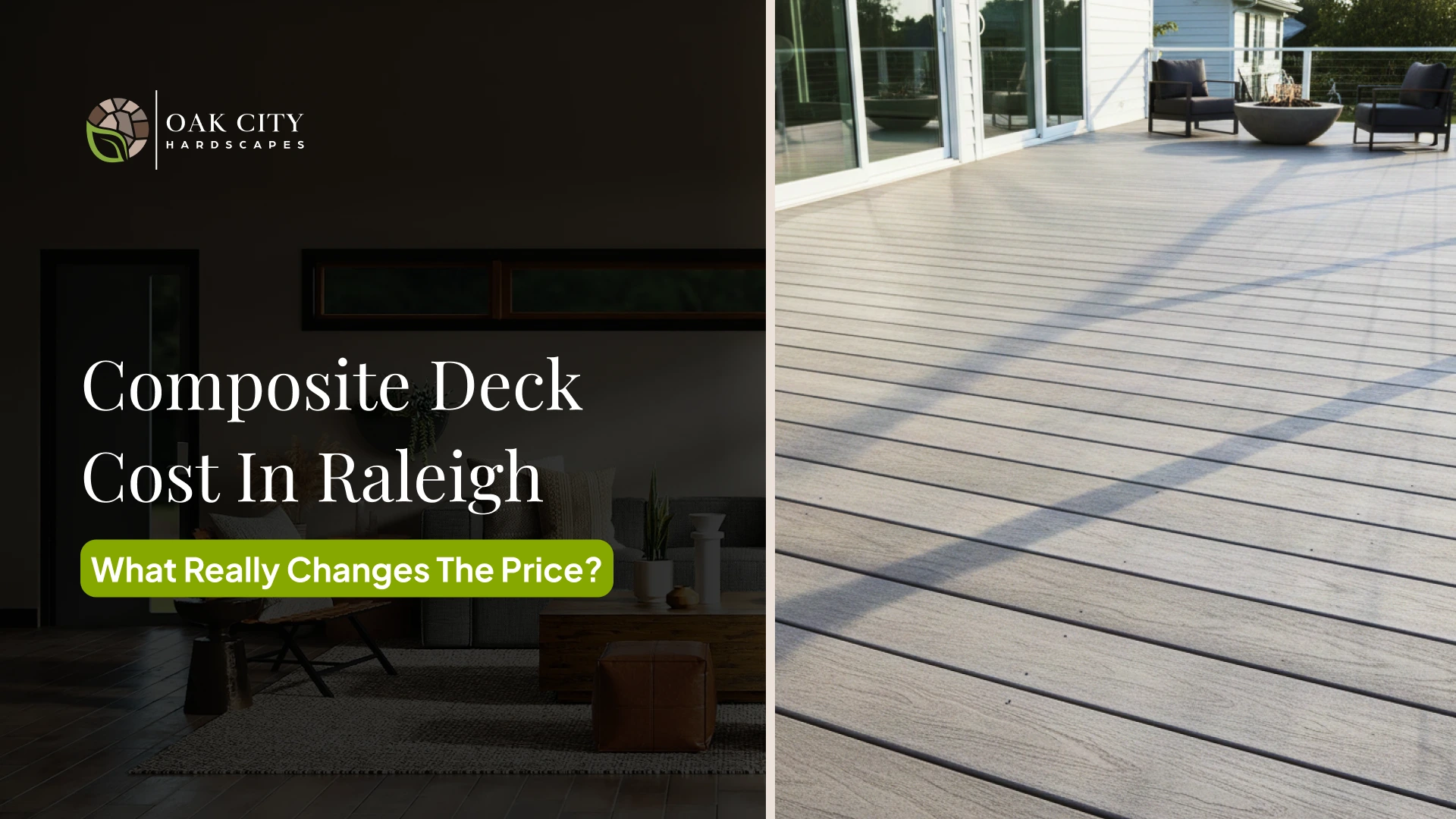
If you have ever collected three quotes for a composite deck in Raleigh and wondered why the spread is thousands of dollars, you are not alone. On paper, every quote can look like “a deck is a deck”, but the price is usually driven by a few high-impact details that are easy to miss until you see them spelled out.
This guide breaks down composite deck cost the way a builder prices it, so you can budget with confidence, compare bids fairly, and avoid paying for surprises halfway through the project.
Quick Price Range For Composite Decks In Raleigh
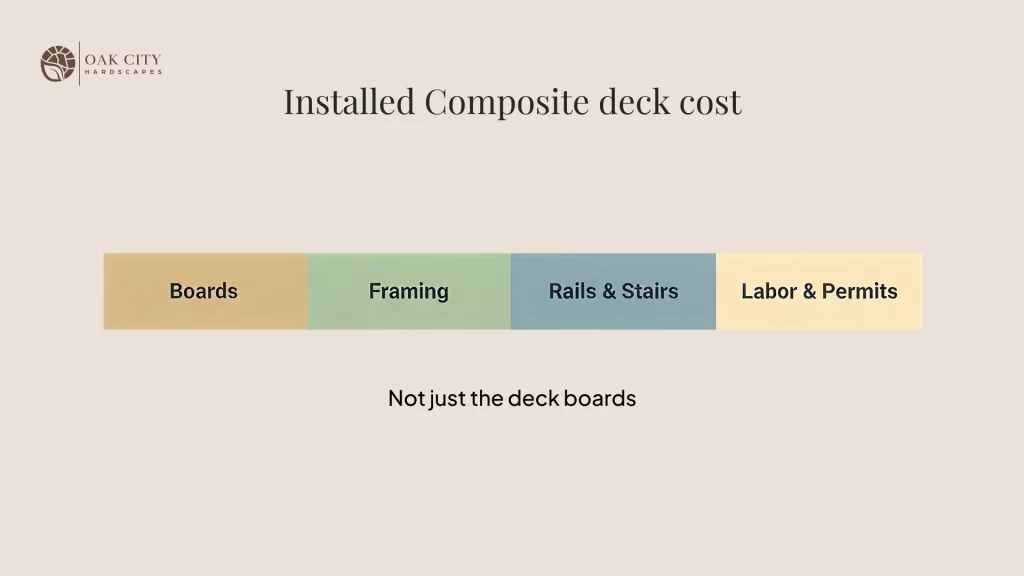
A realistic way to think about composite deck cost in Raleigh is “installed price”, not just the cost of deck boards.
Many national resources cite that an installed composite deck ranges from $40 to $80 per square foot, depending on materials and complexity. Local builders often publish higher starting points for custom composite work that includes footings, framing, rails, and stairs, with new composite builds commonly starting around $80 per square foot and resurfacing style renovations starting around $60 per square foot.
In practice, many Raleigh-area projects fall within a wider band once you account for height, stairs, railing type, and site conditions. As a planning range, expect roughly $60 to $110+ per square foot installed for many professionally built composite decks, with simpler designs on the lower end and elevated, feature-rich builds on the higher end.
What “Per Square Foot” Usually Includes
When a contractor quotes a true installed price, it typically includes: framing, footings, decking surface, fascia, hardware, railings (if required), stairs (if needed), and labor. Some quotes also include a demo of an existing deck, hauling, and permit handling, but not all do.
Why Online Averages And Real Quotes Differ
Manufacturer pages often share material-only estimates that may include substructure and hardware, but not labor, demolition, or local permitting. For example, Trex notes an estimated materials range of about $10 to $27 per square foot (including substructure, decking, hardware, and fasteners), before labor and project-specific needs.
That gap between “materials” and “installed” is exactly where Raleigh-specific variables live.
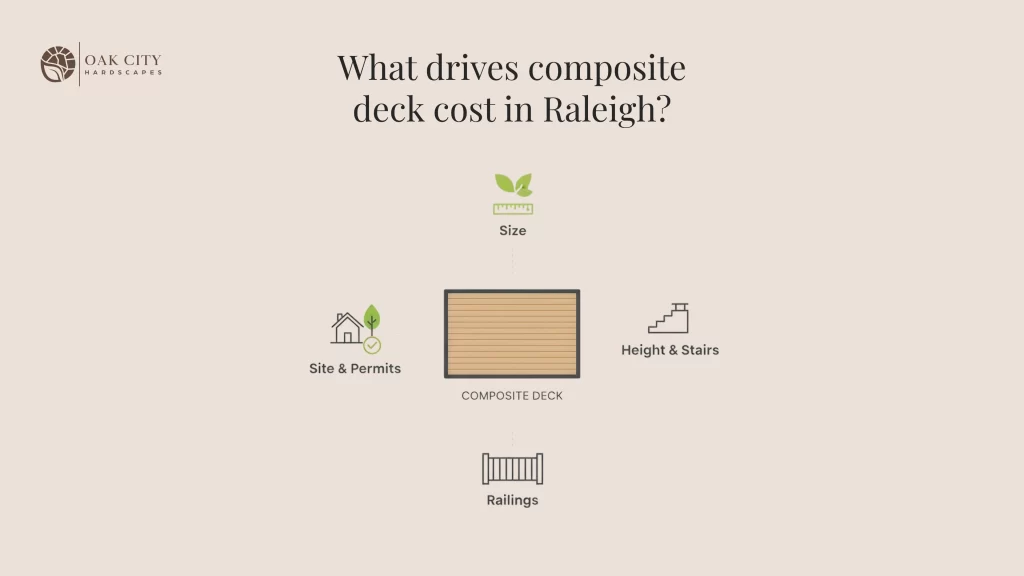
Composite Deck Cost Breakdown
Composite deck pricing is easiest to understand when you separate it into the parts that move the needle.
Decking Boards And Product Lines
Composite boards are not one price. The cost shifts based on:
- Entry, mid, and premium lines (often tied to cap technology, color variation, and warranty)
- Capped composite vs PVC style boards
- Board width, texture, and heat performance
- Color choices that may cost more due to demand or line tier
As a reference point, Raleigh cost guides often place composite material around $10 to $19 per square foot for boards, while broader composite decking guides commonly show materials and labor separated, with labor adding a meaningful portion.
If you want to see the kind of composite projects Oak City Hardscapes builds locally (including Trex selections), their portfolio examples are worth reviewing before you pick a product line.
Framing And Substructure
This is where many “cheap” quotes quietly cut corners.
Your composite surface is only as strong as what it sits on. Costs rise when you need:
- New footings (especially on elevated decks)
- Additional beams or upgraded framing
- Correct flashing and ledger attachment details
- Tighter joist spacing for certain board types or patterns
Local deck safety guidance highlights how code requirements shape framing spans, footings, attachments, and guardrail requirements, all of which affect material and labor hours.
Railings, Stairs, And Safety Requirements
Railings are one of the biggest swing factors in composite deck cost.
Two decks with the same square footage can be priced very differently if one requires:
- A lot of linear feet of railing
- Multiple stair runs and landings
- Premium railing (aluminum, cable, composite systems)
Codes matter here. Raleigh’s deck guidance references guard requirements once the walking surface is about 30 inches above grade, with a typical minimum guard height of 36 inches, along with spacing and load requirements that influence material choice and installation time.
For commercial projects, requirements can be stricter in some cases, and the railing approach should be confirmed early to avoid a late-stage budget surprise.
Labor, Demo, And Disposal
Labor varies based on complexity, access, and the amount of custom work involved. Many cost resources place deck labor in a wide band (for example, $8 to $22 per square foot in some national calculators), with higher complexity pushing higher.
If you are removing an existing deck, demolition and hauling can add a significant chunk to the cost.
Permits, Plans, And Inspections In Raleigh
Permitting is not just a line item; it is time, documentation, and coordination.
The City of Raleigh provides a specific process for decks, screened porches, and balconies, including portal submission, required documentation, and situations where additional approvals apply (historic districts, septic, and more). It also notes that a certified survey is typically required for the submittal package.
If your contractor handles permitting and inspections cleanly, that is real value. Oak City Hardscape’s own customer feedback highlights permit knowledge, architectural drawings, and passing inspections, which is exactly the kind of “behind the scenes” work that protects your budget and timeline.
If you want to talk through your site specifics with a local team, start with Oak City Hardscapes’ deck services and consultation pages.
What Really Changes The Price In Raleigh
Here are the most common price drivers that explain the biggest quote differences.
Size And Shape Complexity
A simple rectangle is almost always cheaper per square foot than:
- Curves and custom angles
- Picture framing borders
- Inlay patterns
- Multiple breakout zones for dining, grilling, and seating
Complex layouts increase cutting, waste, fastening time, and finishing detail time.
Height, Multi-Level Layouts, And Stair Runs
The higher the deck, the more structure it needs and the longer it takes to build safely. Second-story decks and split-level designs often require additional footings, posts, beams, bracing, and longer stairs, which can quickly push the installed price up.
Site Access, Grading, Drainage, And Soil
Raleigh yards often have slopes, tree roots, and tight access. Costs increase when crews must:
- Hand-carry materials due to narrow gates or landscaping
- Build around mature trees or hardscape features
- Manage drainage to protect your foundation and keep the deck area dry
Railing Choice (Composite, Metal, Cable)
If your design has many exposed edges, the railing becomes a major budget item.
Oak City Hardscape’s outdoor living content specifically calls out composite, metal, and cable railings as upgrades over basic wood railings, both for durability and aesthetics.
Add-ons That Change The Total
These are the common “while we’re at it” upgrades that affect total composite deck cost:
- Low-voltage lighting
- Built-in benches or planters
- Privacy screens
- Skirting and under-deck storage
- Under-deck drainage (if you want a dry patio space below)
- Pairing the deck with a patio, walkway, or outdoor kitchen
If you are planning a full outdoor living upgrade, Oak City Hardscapes also builds patios, walkways, retaining walls, and other hardscape features, which can be budgeted together for a more cohesive plan.
Resurface Versus Full Rebuild
If you have an existing deck, one of the smartest cost conversations is whether you can:
- Keep the frame and resurface with composite, or
- Rebuild entirely with new framing and footings
Resurfacing can be cost-effective when the structure is sound and code compliant, but if the frame is aging, out of level, or not built to current standards, replacing it can save you headaches and repair costs later. Manufacturer guidance also notes that the substructure condition can significantly affect overall cost.
Sample Budgets By Deck Size
Below are budgeting examples using a planning band of about $60 to $110+ per square foot installed, which aligns with a mix of local starting points and broader installed ranges, depending on scope.
These are not quotes; they are budgeting ranges to help you plan your project conversations.
| Deck Size | Square Footage | Typical Budget Range | Notes That Commonly Shift Price |
| 12×12 | 144 | $8,640 to $15,840+ | Stairs, railing length, and site access |
| 12×16 | 192 | $11,520 to $21,120+ | Picture frame, fascia, upgraded rails |
| 16×20 | 320 | $19,200 to $35,200+ | Multi-zone layouts, lighting, and drainage |
| 20×20 | 400 | $24,000 to $44,000+ | Height, long stair runs, premium lines |
If you prefer a comparison point from a Raleigh-specific cost guide, Angi’s Raleigh deck cost article cites typical deck builds in the area, often landing around $30 to $50 per square foot, with composite material costing more than pressure-treated wood, which is why composite projects commonly sit above basic wood builds once fully scoped.
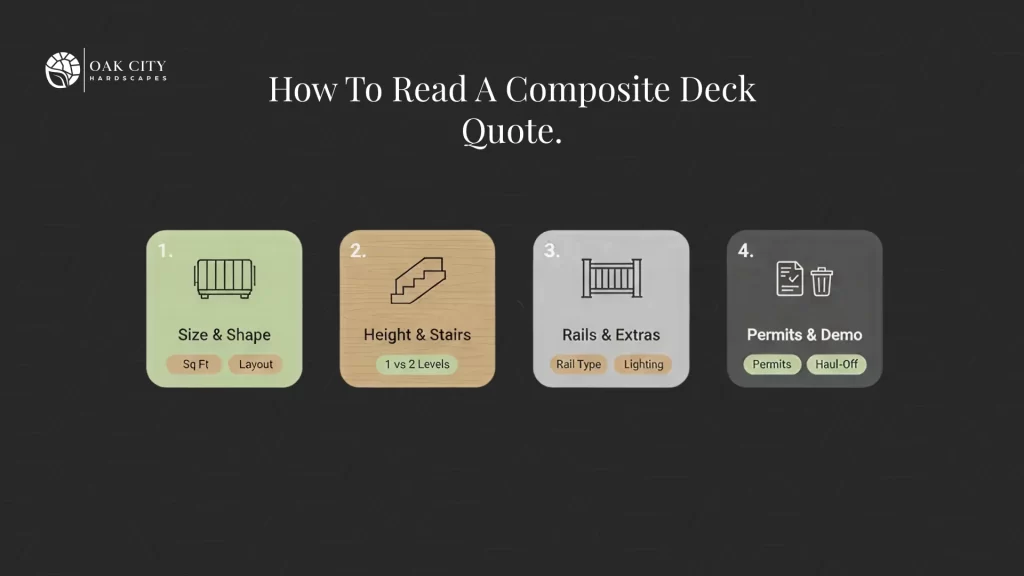
How To Compare Quotes Without Guesswork
If you only remember one section, make it this one.
When quotes vary, it is usually because the scope differs. Ask every bidder to confirm these items in writing:
- Product Line And Color
Include the exact brand and collection, not just “composite.” - Framing Details
Joist spacing, beam sizing, and ledger attachment approach. - Railing Scope
Linear feet of railing, type (composite, aluminum, cable), and post spacing. - Stairs And Landings
Number of steps, width, landings, and handrail approach. - Fascia And Finish Work
Wrapped perimeter fascia, stair stringer finish, skirting (if any). - Permit Handling
Who pulls permits, who provides plans, and who schedules inspections. Raleigh’s process can require specific documents and a certified survey, so confirm this early. - Demo And Hauling
If replacing an old deck, confirm removal, disposal, and site cleanup.
If a quote is significantly cheaper, it is often missing one or more of the above or using lower-spec framing and finishing.
Smart Ways To Control Composite Deck Cost
You can manage cost without cheapening the outcome.
- Keep The Footprint Efficient
A clean rectangle with a single stair run usually offers the best cost-to-function ratio. - Choose A Value Board, Upgrade The Railing
Many people feel the railing visually more than they expect. A smart pairing can look premium without premium boards everywhere. - Avoid Over-Complex Patterns Unless You Truly Want Them
Picture framing and inlays are beautiful, but they increase cutting and labor. - Decide Early If You Want Under-Deck Use
If you want a dry space underneath, plan drainage from day one. Retrofits can cost more. - Bundle Outdoor Living Work
If you are also planning a patio, walkway, or retaining wall, combining scopes can reduce mobilization and create a better overall layout.
Why Composite Often Wins Long Term In Raleigh
Raleigh’s hot, humid summers and wet seasons are rough on wood. Composite is popular here because it reduces the ongoing costs of staining, sealing, and board replacement.
Many composite decking resources estimate a typical lifespan of 25 to 30 years, and manufacturers back certain lines with long residential warranties, including fade and stain coverage, depending on the product and use case.
For commercial projects, carefully confirm warranty terms, as coverage can differ between residential and commercial installations.
If you are weighing material options for a property where durability and low maintenance matter, composite materials often justify their upfront cost.
Frequently Asked Questions
How Much Does A Composite Deck Cost Per Square Foot In Raleigh?
Many composite decks in the Raleigh area budget roughly $60 to $110+ per square foot installed, depending on height, stairs, railings, site conditions, and product line. Local starting points for custom composite work are often cited around $60 per square foot for renovations and around $80 per square foot for new builds, with complexity pushing higher.
How Much Does A 12×16 Composite Deck Cost In Raleigh?
A 12×16 deck is 192 square feet. Using a planning band of $60 to $110+ installed, that often budgets around $11,520 to $21,120+, with stairs and railing choices being the most common swing factors.
Do I Need A Permit To Build A Deck In Raleigh?
Yes, most decks, screened porches, and balconies require permitting, with a defined submittal process through the city portal, and required documentation that can include a certified survey and other approvals depending on the property (historic district, septic, and more).
What Adds The Most Cost To A Composite Deck?
The biggest cost drivers are usually deck height and structure, stair runs, railing type and total linear feet, site access and grading, and complexity like multi-level layouts or custom patterns.
Can I Put Composite Boards On My Existing Deck Frame?
Sometimes, yes, if the existing framing is structurally sound, properly spaced for the composite you choose, and meets code requirements. If the frame is aging, out of level, or built with older standards, a rebuild is often safer and more cost-effective long term.
Where Can I See Examples Of Local Composite Deck Builds?
Oak City Hardscapes shares local project examples in their portfolio, including composite decks built with specific Trex product lines.
Conclusion
The cost of a composite deck in Raleigh is not just about square footage. The real price change happens in the structure, the rails, the stairs, the site conditions, and the permitting details that keep the project safe and smooth.
If you want an estimate that is easy to compare and hard to misunderstand, start by reviewing Oak City Hardscape’s deck services, then schedule a consultation to walk through your site and goals.
Key Takeaway
- Expect composite deck cost in Raleigh to vary most based on height, stairs, railings, and site access, not just size.
- Material-only numbers are not installed numbers; framing and labor are where budgets shift.
- Raleigh permitting can require specific documentation, so confirm who handles plans, surveys, and inspections early.
- Compare quotes by scope details (product line, framing, rails, stairs, demo, permits) to avoid hidden gaps.
- Composites often cost more upfront, but can reduce long-term maintenance and replacement cycles in Raleigh’s climate.