
It starts the same way almost every time. Someone is standing at their grill on a Tuesday night, foil-wrapped corn going soft on a folding table, propane tank running low, and they think: this could be so much better. Twenty minutes later they’re typing “outdoor kitchen contractors near me” into their phone, half expecting the internet to hand them a name they can trust. It doesn’t. It hands them a list.
The Search That Starts in Your Backyard and Ends in a Rabbit Hole
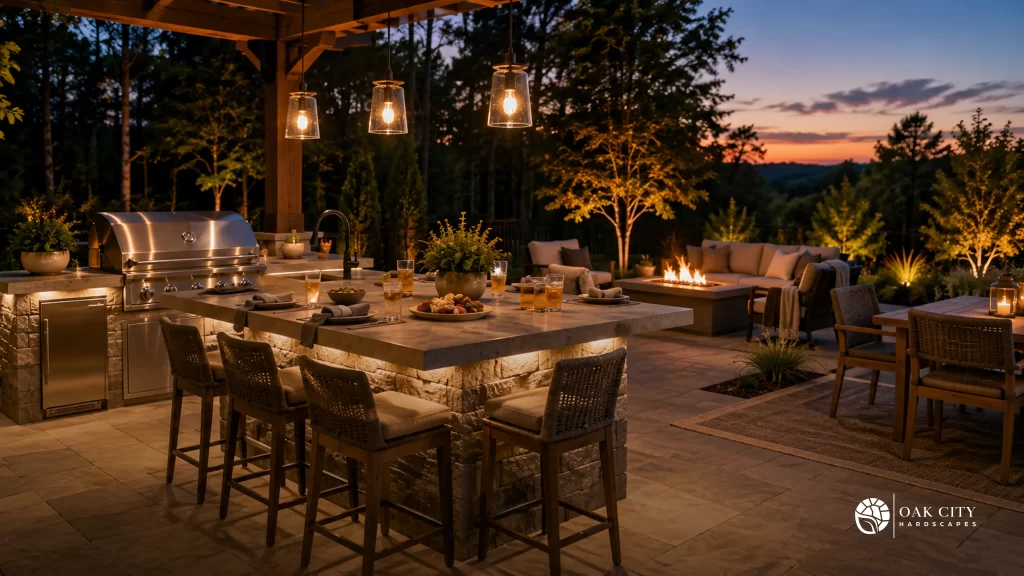
Here’s the thing about “outdoor kitchen contractors near me.” It sounds like a simple search. It isn’t. Type it in, and you get a wall of ads, a scattering of five-star review pages that might be real, and at least one contractor whose entire portfolio is three stock photos of a grill island that could be anywhere from Cary to Sacramento.
Homeowners in Apex, Durham, and Holly Springs run this search every week, and most of them aren’t shopping for a grill cart. They’re picturing something bigger. A weeknight where dinner happens outside because it’s easier, not because it’s an event. A Saturday where the in-laws show up and nobody’s stuck inside prepping while everyone else is on the patio. That vision is the whole point. The contractor you pick decides whether you get it.
Contractor or Craftsman? The Difference Nobody Explains
Every outdoor kitchen contractor near you can pour concrete and stack block. Not every one of them can tell you why your countertop needs a different edge profile than your neighbor’s, or why the gas line routing on your project isn’t the same as the last job they finished three streets over.
That gap matters more than most homeowners realize going in. A contractor builds what’s on the drawing. A craftsman asks why the drawing says what it says, and pushes back when something won’t hold up to a Raleigh July. One Oak City Hardscapes client, Paul Levering, put it simply after his project wrapped: the crew was patient through every material selection and paid attention to details most people would have rushed past. That’s not a marketing line. That’s what happens when the person on-site actually owns the outcome.
The Six Questions That Separate the Real Ones from the Rest
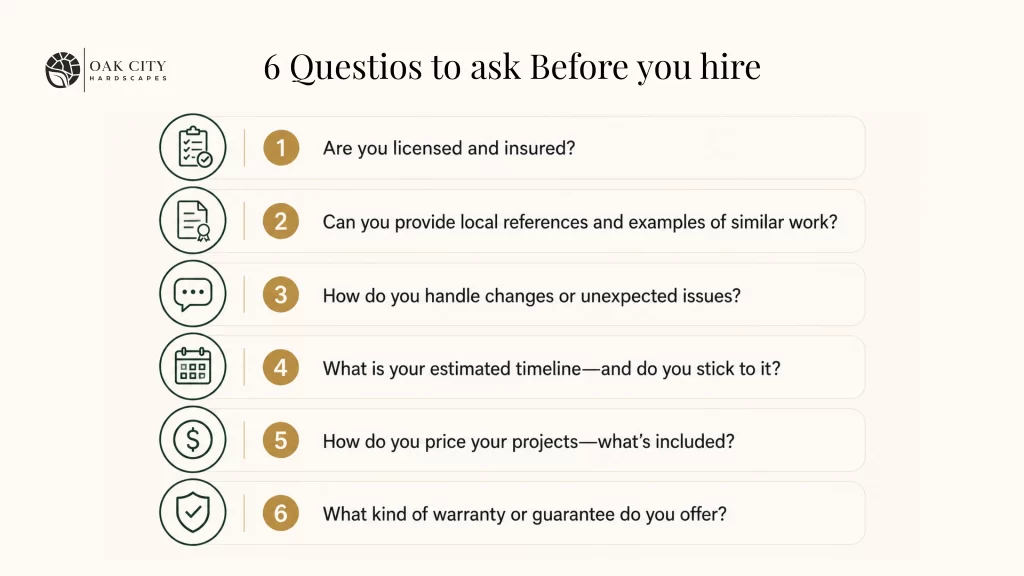
Before you hand anyone a deposit check, ask these six things. If a contractor hesitates on more than one, that’s your answer.
Are you licensed for this specific scope of work? In North Carolina, any project over $30,000 is legally required to have a licensed general contractor. Outdoor kitchens with gas, electrical, or plumbing tie-ins often cross that line fast.
Who pulls the permits, and who’s responsible if an inspection fails? This should never be a homeowner’s job to figure out mid-project.
Can I see a project with a similar scope, not just a similar style? A pretty photo means nothing if the layout, materials, or utility routing were completely different.
What happens if we hit something underground? Every backyard has a story nobody knows until the shovel hits it. A real contractor has a plan for that conversation before it happens.
Is the quote itemized, or is it one number? One number is a red flag. You want to see cabinetry, countertop, appliances, gas and electrical work, and labor broken out separately.
Who’s actually on-site during the build? Not the sales rep. The person swinging the tools.
The Permit Problem Nobody Warns You About
Here’s where a lot of backyard dreams quietly stall out. Raleigh requires permits for most outdoor kitchen builds, especially those involving gas lines, electrical circuits, or structural additions such as a covered cooking area. Skip that step, or hire someone who skips it for you, and you’re not just risking a fine. You’re risking a failed inspection that stops the whole project cold, or worse, a problem that surfaces years later when you try to sell the house and the buyer’s inspector asks for permits that were never pulled.
The City of Raleigh’s residential permit process exists for a reason, and it’s not bureaucratic busywork. It’s the difference between an outdoor kitchen that’s built to code and one that’s a liability with a nice countertop on top of it. Ask your contractor directly: who is filing this, and what happens if the first inspection doesn’t pass. A contractor who’s confident in that answer has probably done it dozens of times. A contractor who gets vague has probably done it zero.
What’s Actually Inside an Outdoor Kitchen (And Why It Matters)
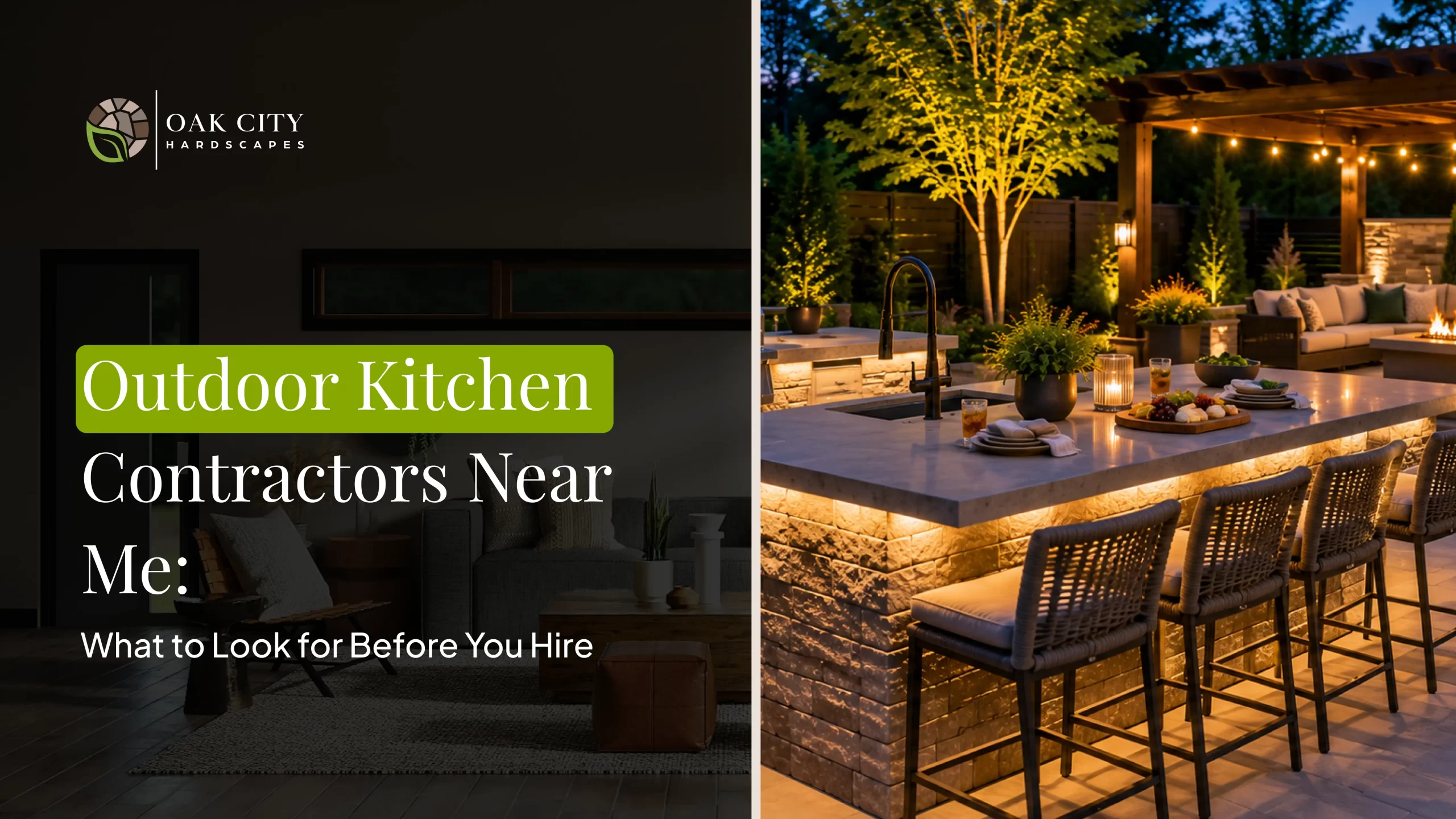
An outdoor kitchen isn’t a grill with a countertop bolted next to it, even though that’s how many contractors quote it. A real build accounts for cabinetry rated for outdoor exposure, weatherproof electrical systems, gas lines sized correctly for the appliances you’re running, and a countertop material that can survive a Carolina summer without cracking, staining, or bleaching out by year two.
The National Kitchen and Bath Association’s planning guidelines now include a full section on outdoor spaces for exactly this reason. Layout matters just as much outside as it does in your indoor kitchen. Work triangle spacing, counter clearance near the grill, and the sink’s position relative to the prep space. Skip that line of thinking, and you end up with something that photographs well but is genuinely annoying to cook.
This is also where patios and hardscapes come into the conversation, since the kitchen almost never stands alone. It needs a surface beneath it, seating nearby, and usually a covered structure overhead. The best contractors think about the whole space, not just the appliance island.
The Lowest Bid Is Not the Deal You Think It Is
Every homeowner wants three quotes and a clear winner. But when one bid comes in dramatically lower than the other two, that’s not a deal. That’s a question you haven’t asked yet.
Low bids usually mean one of three things: cheaper materials that won’t hold up, corners cut on permitting and code compliance, or a change order strategy where the real price shows up in month two. None of those save you money. They just delay the bill and add stress to the delivery.
Gas and electrical work is not the place to shop on price alone. The NFPA’s grilling and outdoor cooking safety guidance exists because improperly installed gas lines and appliance clearances cause real fires every year, not hypothetical ones. A contractor who’s cutting corners on cost is often cutting corners on exactly the parts of the build you can’t see once the countertop goes on.
Red Flags That Should Send You Straight to the Next Name on the List
A few signs are worth walking away from immediately. No physical address, only a phone number and a Facebook page. Reluctance to put the scope of work in writing. Pressure to sign on the same day for a “discount.” A portfolio with no local projects at all. And the biggest one: a contractor who can’t clearly explain who’s handling permits and inspections.
None of these are dealbreakers in isolation, necessarily. But two or more together means it’s time to call the next name on your list.
Why Raleigh Homeowners Choose Oak City Hardscapes for Outdoor Kitchens
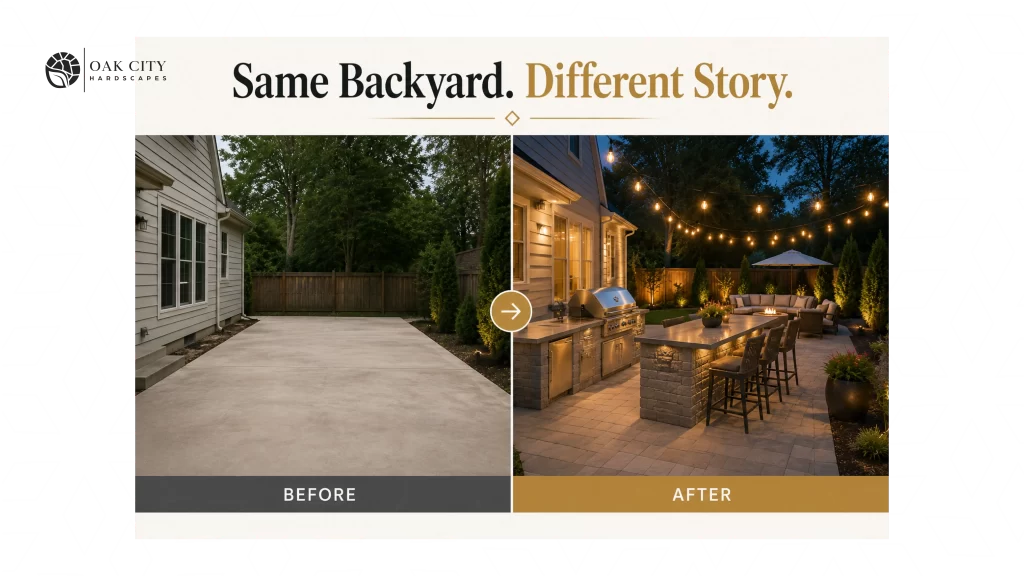
If you’re comparing outdoor kitchen contractors near Raleigh, Cary, or Apex, the decision usually comes down to one question: who’s actually going to be on your property when the work happens. At Oak City Hardscapes, that answer is Max Laing and Grayson Boyd, the founders, not a rotating crew you’ve never met. After a combined decade in paving, commercial concrete, and general contracting, they built the company on what they call a relentless pursuit of perfection, and that shows up in the small decisions homeowners never see coming, like how a gas line gets routed or where a countertop seam falls.
Oak City’s outdoor kitchens are designed and quoted as part of the full outdoor living picture, not bolted on as an afterthought. That means a kitchen build often connects directly to a deck or patio project, with a single team handling design, permitting, and construction from the initial sketch to the final inspection. Every project receives architectural drawings before any contract is signed, and every permit application goes directly to Oak City, which is a big part of why their inspections consistently pass on the first try.
Homeowner Audrey Bennett’s experience is a good example. Every inspection of her project passed on the first try, and the team worked with her to develop architectural drawings so she could see the final design before construction ever started. That’s not a lucky outcome. That’s what happens when permitting and design are treated as part of the build, not an afterthought handled separately. You can see examples of finished outdoor living spaces across the Triangle in the Oak City portfolio, and book a consultation to start the conversation about your own backyard.
FAQs
Q: How much does an outdoor kitchen cost in the Raleigh area?
Costs vary widely based on materials, appliances, and layout, but most custom builds range from the low five figures to well over $50,000. Get an itemized quote so you know exactly what’s driving the number.
Q: Do I need a permit for an outdoor kitchen in Raleigh?
In most cases, yes, especially if gas lines, electrical work, or a covered structure are involved. Your contractor should handle this directly rather than leaving it to you.
Q: How long does an outdoor kitchen build typically take?
Most projects take four to eight weeks from permit approval to completion, depending on scope, weather, and the custom nature of the design.
Q: Can an outdoor kitchen be added to an existing patio?
Often, yes, though the existing surface needs to be evaluated for structural support and utility access before design begins.
Q: What’s the difference between a stock grill island and a custom outdoor kitchen?
A stock island is a prefabricated unit dropped into place. A custom build is designed around your layout, appliances, and how you actually use the space.
Q: Should I choose gas or electric appliances for an outdoor kitchen?
Gas is more common for grills and requires proper line sizing and code compliance. Electric works well for smaller appliances but has its own clearance and wiring requirements.
Q: What materials hold up best to North Carolina weather?
Countertops and cabinetry rated specifically for outdoor exposure hold up far better than indoor materials repurposed outside, especially through humid summers and freeze-thaw winters.
Conclusion
There’s a version of your backyard that exists right now only in your head, the one where dinner happens outside without a second thought and nobody’s stuck running back inside for something they forgot. Getting there isn’t about finding the flashiest contractor on page one of Google. It’s about finding the one who answers the hard questions before you ask them, pulls the permits without being told to, and shows up on-site instead of sending someone who’s never seen your yard. Ask the right questions, watch for the right red flags, and that backyard stops being a someday project and starts being a Tuesday night.
Key Takeaways
- Not every outdoor kitchen contractor near you is licensed for gas, electrical, or high-value scopes over $30,000.
- Permits are not optional in Raleigh, and skipping them can lead to failed inspections or resale problems later.
- An itemized quote protects you far more than a single lump-sum number ever will.
- The lowest bid often hides costs in cheaper materials or corners cut on code compliance.
- Ask who is physically on-site during your build, not just who signs the contract.
- Outdoor-rated cabinetry and countertops matter more than they appear to in a showroom.
- A real outdoor kitchen design accounts for layout and workflow, not just appliance placement.
- Multiple red flags together, like no local portfolio or vague answers to permit questions, are reasons to walk away.
- The best outdoor kitchen builds are planned as part of the full outdoor living space, not in isolation.
- Architectural drawings before signing a contract let you see the design before you commit to it.
Ready to see what your backyard could actually look like? Book a free consultation with Oak City Hardscapes and get a design built around how you really use your space.