
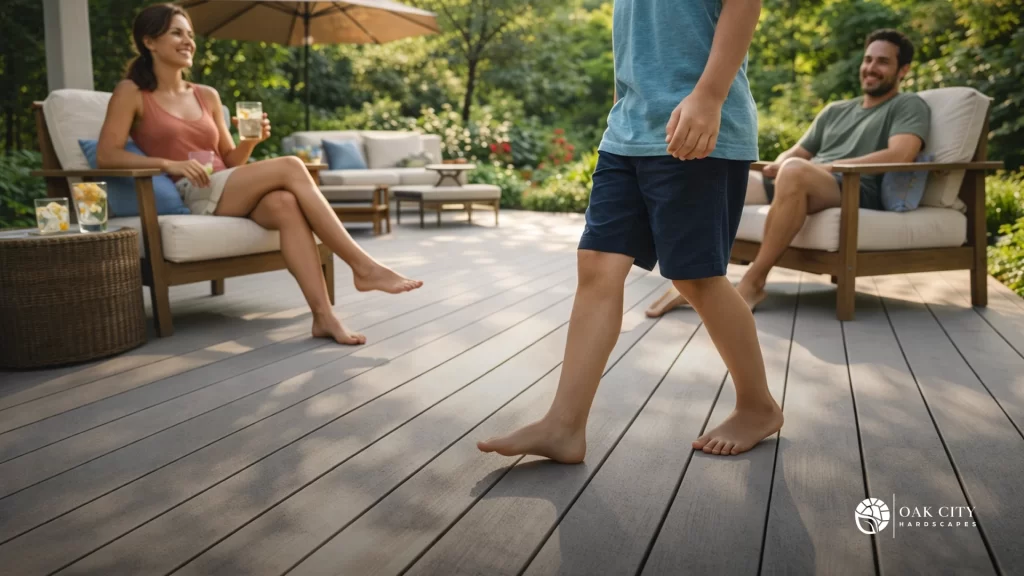
The first weekend you really use your deck in summer tells you everything. Shoes disappear. Kids sprint outside. The dog claims the shady spot. Someone steps out with a cold drink and bare feet, and suddenly, the surface temperature matters as much as the look.
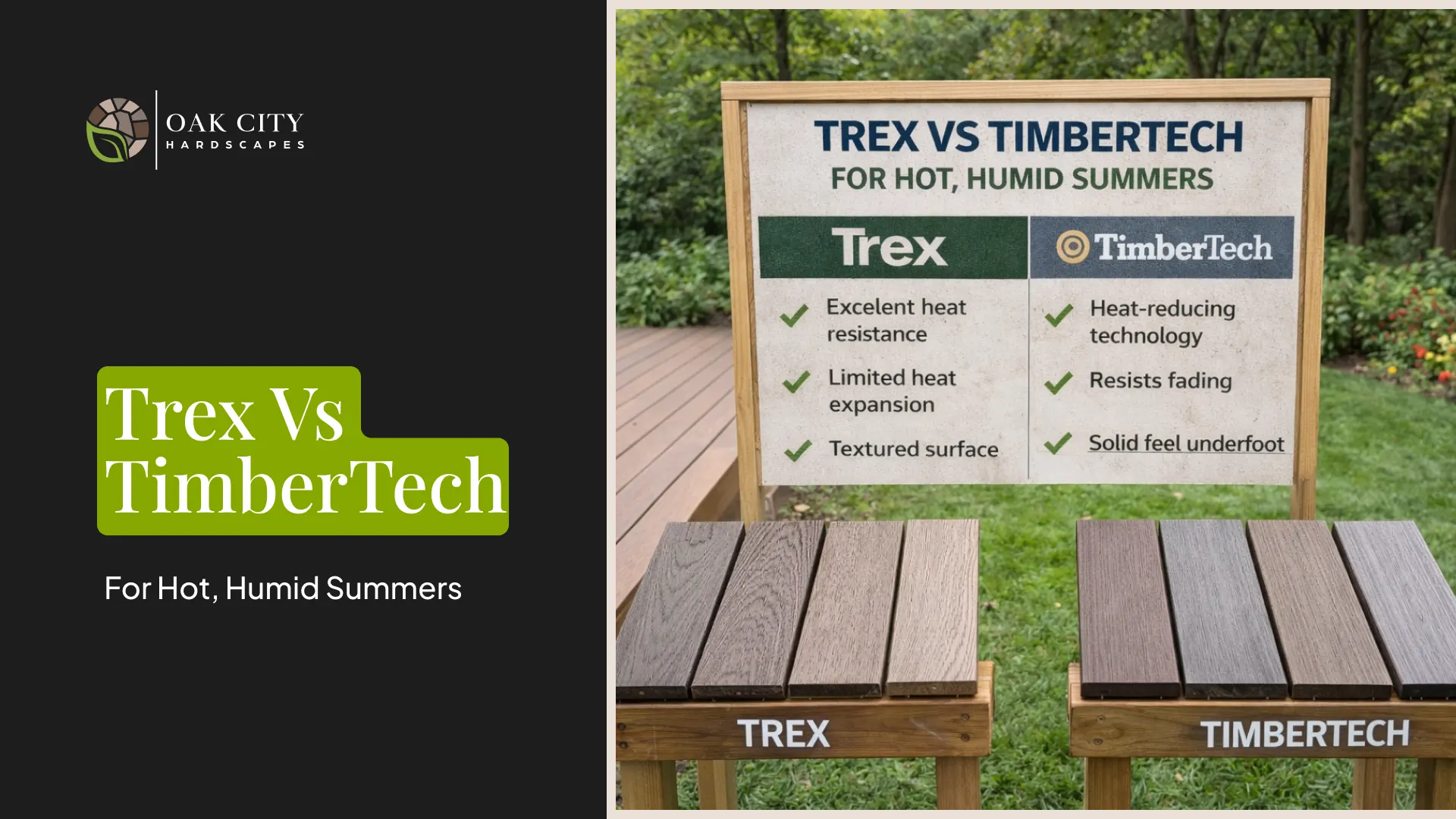
If you are deciding between Trex and TimberTech, the smartest choice is not about which logo is “better.” It is about how your deck will feel and perform in your specific conditions, especially when heat and humidity co-occur.
This guide compares Trex vs TimberTech with a national, hot-and-humid focus: sun exposure, moisture behavior, traction after storms, and the warranty differences that are easy to miss.
Hot And Humid Weather: What Your Deck Is Up Against
Hot and humid climates across the U.S. create a few predictable deck challenges:
- Surface heat in direct sun, especially on darker colors and unshaded areas.
- Moisture that lingers after rain, irrigation, or morning dew, especially in shaded backyards or low-airflow spaces.
- Pollen, dirt, and organic debris form a film. That film can feed mold and mildew on any outdoor surface if it sits long enough. Trex specifically notes that pollen and dirt left on the surface can provide a food source for mold, and recommends routine cleaning to remove it.
The goal is not perfection. The goal is to choose a material and build approach that stays comfortable underfoot, resists the annoying moisture-related side effects, and is easy to maintain.
Trex Vs TimberTech: The Differences That Matter Most
At a practical level, your decision usually comes down to two things:
- Do you want composite with heat-mitigating options, or PVC options positioned for maximum moisture resistance and comfort?
- Do you need the best performance in full sun and near-water conditions, or the best value-to-performance balance for a standard backyard deck?
Trex highlights heat-mitigating decking through its SunComfortable Technology and positions it as engineered to reflect solar energy and reduce heat absorption.
TimberTech offers both composite and Advanced PVC lines, and its messaging strongly emphasizes four-sided capped composite protection and the benefits of Advanced PVC for comfort and in moisture-prone environments.
Heat Performance In Full Sun
If your deck gets direct afternoon sun, heat becomes a daily comfort issue, not a minor detail.
Trex Heat Options
Trex states that SunComfortable Technology reduces heat buildup by up to 35 degrees Fahrenheit compared to its original boards.
Trex also highlights SunComfortable on specific product lines like Transcend Lineage.
TimberTech Heat Options
TimberTech positions Advanced PVC as specifically engineered to reflect more sunlight and retain less heat, and states that several colors can stay up to 30 degrees cooler than many competitive products.
For specific Advanced PVC collections, TimberTech states boards stay up to 30 degrees cooler to the touch and includes a note that all decking products can still get hot in the sun, with darker colors feeling hotter.
National Heat Takeaway
If barefoot comfort is your top priority in full sun, compare Trex boards with SunComfortable Technology to TimberTech Advanced PVC in lighter colors. Color and shade still matter a lot, even within “cooler” lines.
Humidity, Moisture, And Mold: What Actually Matters
Humidity rarely ruins a deck overnight. It shows up in the small frustrations: surfaces that stay damp longer, more frequent film buildup, and the need for consistent cleaning.
Trex On Mold And Surface Film
Trex notes that mold can feed on a biofilm when pollen and dirt remain on the decking surface, and recommends cleaning with a hose, warm, soapy water, and a soft-bristle brush to remove the food source and mold.
TimberTech On Moisture Resistance
TimberTech’s composite overview emphasizes four-sided protective polymer capping and “zero wood fibers” for superior moisture resistance, including protection even in the grooves.
TimberTech’s Advanced PVC overview states that its 100% synthetic composition is moisture-resistant and “won’t warp, swell, or deteriorate from water exposure,” and that it offers improved traction in wet areas.
What This Means For Humid Climates
If your deck is shaded, close to the ground, surrounded by trees, or in a yard that stays damp, moisture behavior and airflow matter as much as brand choice. In those conditions, TimberTech’s moisture positioning for capped composite and Advanced PVC is worth comparing closely, while Trex can still perform well when the design supports drainage and you keep up with routine cleaning.
Traction And The “Slick Deck” Problem After Rain
In humid regions, traction is not just a pool-deck issue. Summer storms, irrigation, and morning dew can make any deck feel slick if pollen and debris build up.
TimberTech states that Advanced PVC decking can have 40% better traction, wet or dry, than competitive products, and it highlights this benefit for areas near water.
No material is immune to surface film. For reliable traction, pair the right decking with a simple cleaning routine. TimberTech recommends periodic full-scale cleaning at least twice per year for composite decking.
Warranties: What To Compare Before You Decide
Do not compare warranties at the brand level only. Compare the exact line being quoted.
Trex Warranty Snapshot
Trex states its limited residential warranties range from 25 to 50 years, depending on the product.
Trex also highlights that its decking and railing products are backed by 25-, 35-, and 50-year limited warranties.
TimberTech Warranty Snapshot
TimberTech offers Advanced PVC with a Limited Lifetime Product Warranty and a 50-Year Fade & Stain Limited Warranty, and its composite lines typically offer 25- to 30-year warranty terms, depending on the collection.
Warranty Takeaway
When comparing bids, ask your contractor to write the exact product line and collection name on the quote. That is the only way to compare apples to apples.
Quick Comparison Table
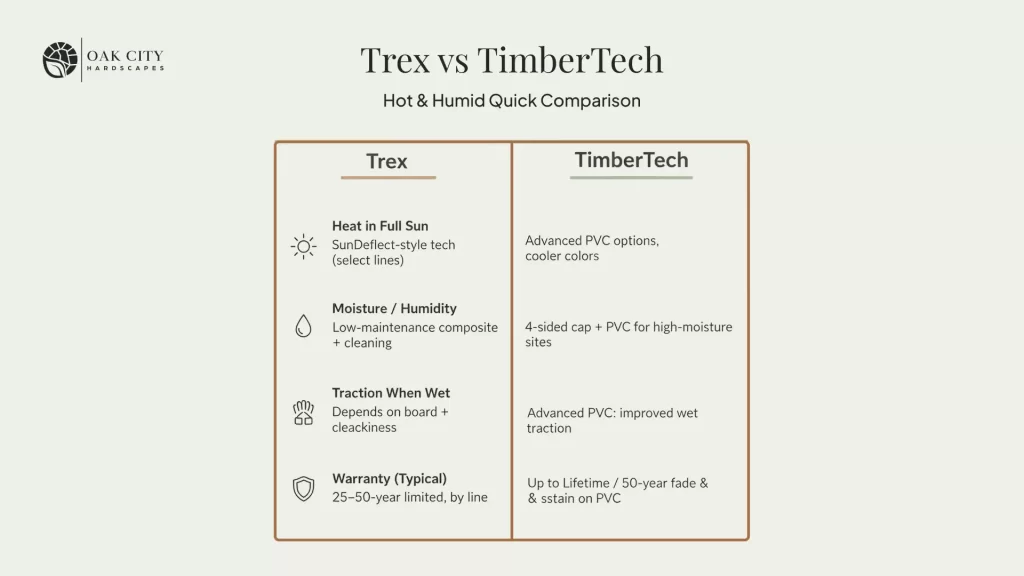
| Category | Trex | TimberTech |
| Heat Comfort In Full Sun | SunComfortable Technology on select lines, up to 35°F reduced heat buildup vs original boards | Advanced PVC positioned for heat mitigation, some colors up to 30° cooler than competitive products |
| Moisture And Humidity | Trex notes that mold can feed on biofilm from pollen and dirt, and routine cleaning helps | Composite emphasizes a four-sided cap and zero wood fibers. Advanced PVC is 100% synthetic and moisture-resistant |
| Traction After Rain | Depends on board and cleanliness | Advanced PVC claims 40% better traction wet or dry than competitive products |
| Warranty Range | Limited residential warranties stated as 25 to 50 years depending on product | Advanced PVC: Limited Lifetime Product plus 50-Year Fade & Stain, Composite: typically 25 to 30 years |
Which One Should You Choose: Easy Scenarios
Use these scenarios to make the decision simpler.
Choose Trex When
- You want a strong value-to-performance balance and a widely available composite brand.
- Your deck is in full sun and you plan to choose a Trex line that includes SunComfortable Technology.
- You want a low-maintenance surface and you are comfortable with routine cleaning to manage pollen film and surface growth.
Choose TimberTech When
- Your yard is shaded, damp, or low-airflow and you want to prioritize moisture resistance in the material system.
- Barefoot comfort in full sun is your top concern and you want to compare Advanced PVC heat positioning.
- The deck is near a pool or water feature and traction is a primary filter, not an afterthought.
If You Are Still Torn, Use This Simple Filter
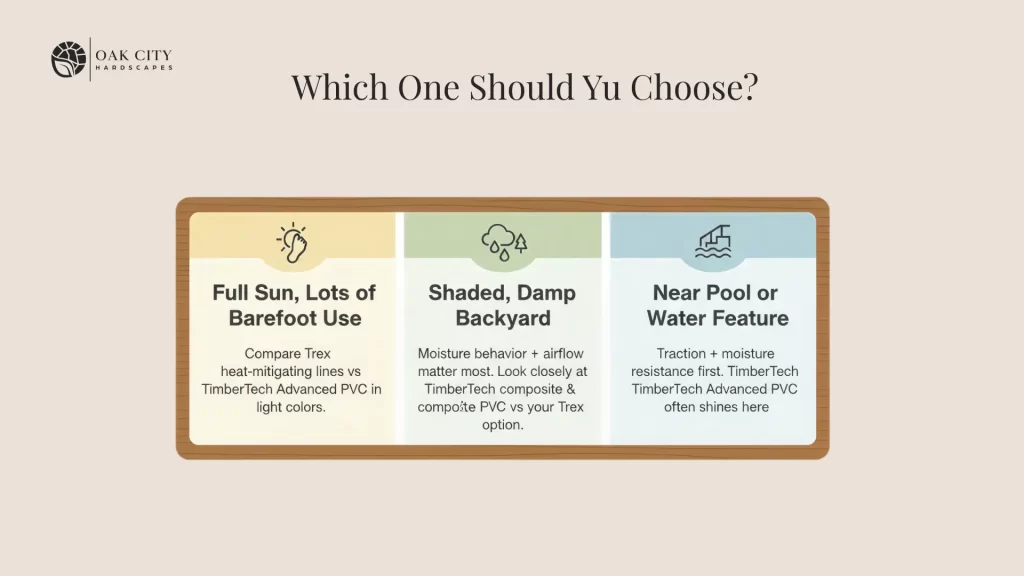
- Full sun and lots of barefoot use: compare Trex SunComfortable lines vs TimberTech Advanced PVC in lighter colors.
- Shaded and slow to dry: put moisture behavior and airflow at the top, then compare TimberTech composite and Advanced PVC options against the Trex line you are considering.
- Near-water or frequent wet use: traction plus moisture resistance matters more than price differences.
How Oak City Hardscapes Helps You Choose The Right System
The “best” decking is the one that matches your site conditions and how you actually use the space.
When we help homeowners choose materials, we focus on:
- Sun exposure patterns (morning vs afternoon heat)
- Airflow and clearance under the deck
- Drainage paths and splash zones (pools, hot tubs, downspouts)
- Where people naturally walk barefoot
- Cleaning reality, not cleaning fantasy
If you want help selecting the right decking system and building details that support long-term comfort, explore our Custom Deck Services, review our Portfolio, or book a Consultation.
Frequently Asked Questions
Which Stays Cooler In Full Sun, Trex Or TimberTech
It depends on the specific product line and color. Trex states SunComfortable can reduce heat buildup by up to 35°F compared to its original boards, while TimberTech states Advanced PVC can stay up to 30° cooler than many competitive products in certain colors.
Does Humidity Cause Mold On Composite Decking
Humidity, along with pollen and dirt, can create conditions for surface growth. Trex notes that mold can feed on a biofilm when debris remains on the surface, and routine cleaning helps remove the food source.
Is TimberTech Better For Moisture Than Trex
TimberTech positions its capped composite as four-sided, capped, with zero wood fibers for moisture resistance, and its Advanced PVC is 100% synthetic and moisture-resistant. Trex emphasizes low maintenance and provides cleaning guidance to manage surface mold and mildew. The best choice depends on your deck’s airflow, shade, and how wet the space stays.
Which Is Better For A Shaded Backyard
Shaded decks stay damp longer, so moisture behavior and cleaning matter more. Many homeowners compare TimberTech composite and Advanced PVC options closely for these conditions, while also planning for routine cleaning regardless of brand.
Will Either One Still Feel Hot In Summer
Yes, any decking can get hot in direct sun, and darker colors generally feel hotter. TimberTech explicitly notes this on its heat guidance and product pages.
Conclusion With Key Takeaway
Trex vs TimberTech is not a one-winner decision, especially in hot, humid regions. The right pick depends on sun exposure, how wet your site stays, and whether traction and barefoot comfort are daily needs or occasional nice-to-haves.
Key Takeaways:
- Compare product lines, not just brand names, since heat and warranty features vary by collection.
- For full-sun comfort, compare Trex SunComfortable lines to TimberTech Advanced PVC in lighter colors.
- For shaded or damp yards, moisture behavior and airflow are critical, and TimberTech emphasizes four-sided capped composite plus moisture-resistant Advanced PVC.
- For pools and frequent wet use, traction deserves top priority, and TimberTech Advanced PVC claims 40% better traction.
- In humid climates, cleaning is part of ownership. Trex notes that pollen and dirt can feed mold biofilms, so routine cleaning helps protect the surface’s appearance and feel.