
Raleigh homeowners spend real money on their outdoor spaces. And the one thing that kills a patio project faster than a bad contractor is choosing the wrong material.
The wrong hardscape material in North Carolina’s climate means cracking, fading, shifting, and expensive repairs within five years. The right one means a patio that looks as good in year fifteen as it did on install day.
Here is a direct comparison of the three most common hardscape materials for patios in Raleigh, what each one actually costs, and what holds up in this specific climate.
What Counts as a Hardscape Material
Hardscape is anything non-living in your outdoor space. Patios, walkways, retaining walls, fire pit surrounds, and pool decks. The material you choose for those surfaces determines durability, maintenance, and how much you will spend over the life of the project.
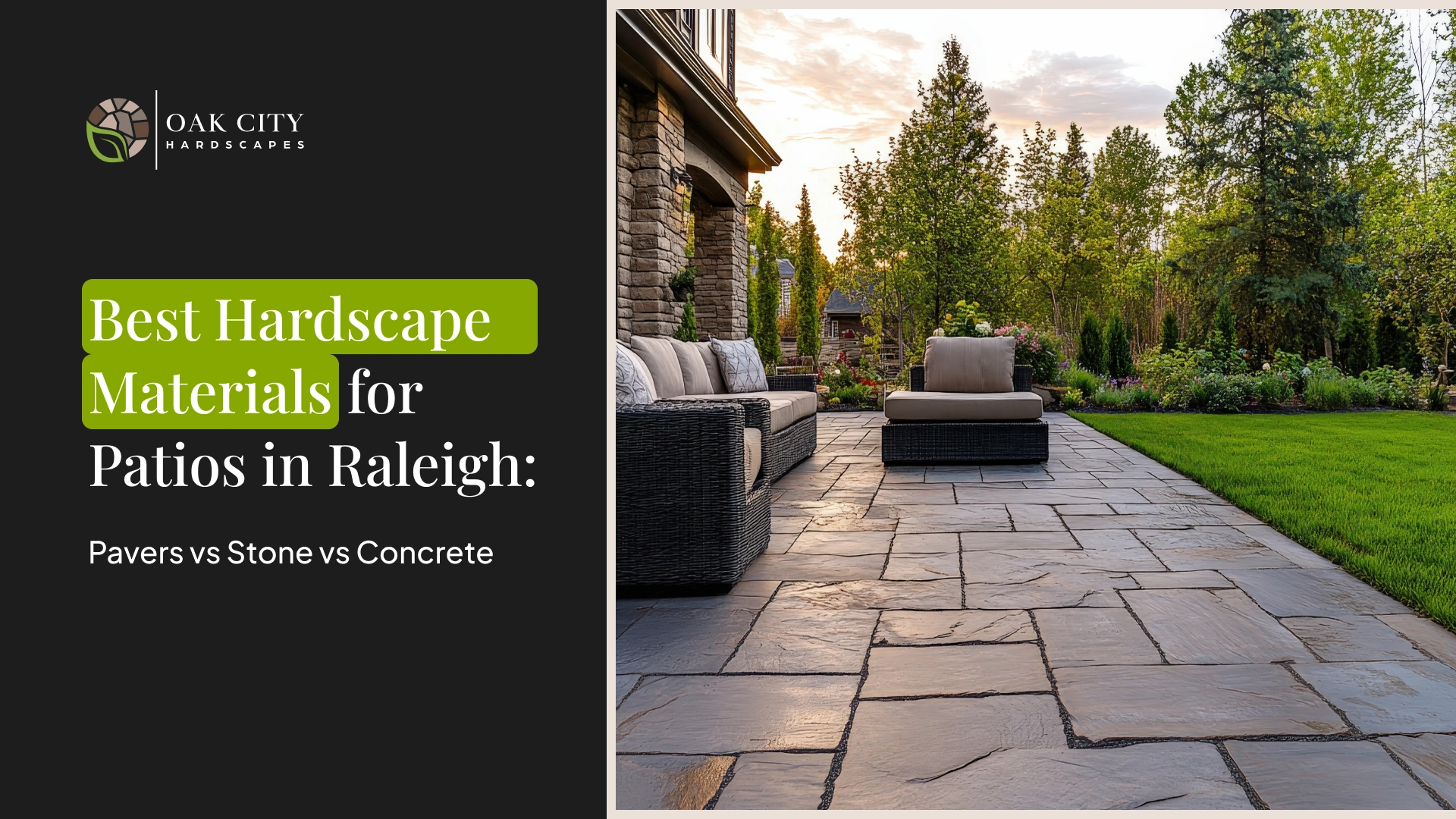
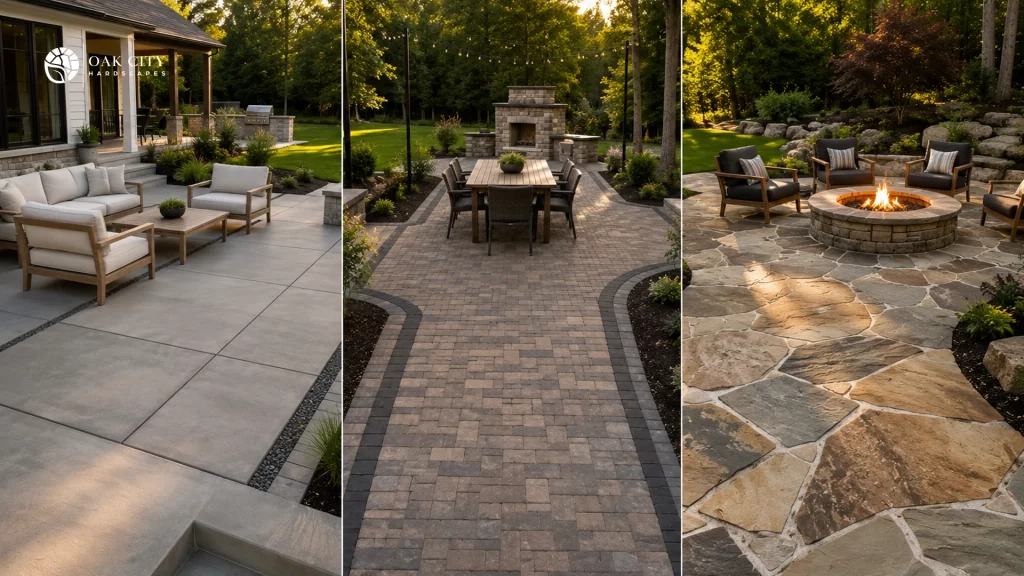
For patios specifically, the three options that dominate Raleigh installs are concrete pavers, natural stone, and poured concrete. Each works differently. Each has a price range. And each holds up very differently in the Triangle’s heat and freeze cycles.
Why Raleigh’s Climate Changes the Decision
Raleigh gets hot summers and genuine freeze-thaw cycles in winter. Temperatures routinely dip below freezing from December through February. That matters because water expands when it freezes. Any patio surface with cracks, seams, or porous material is vulnerable.
According to NC State University’s climate data, the Triangle averages 12 to 15 freeze-thaw events annually. Over ten years, that is 120 to 150 freeze-thaw cycles working against your patio surface.
This is not about aesthetics. It is about what survives.
Pavers: The Most Versatile Option
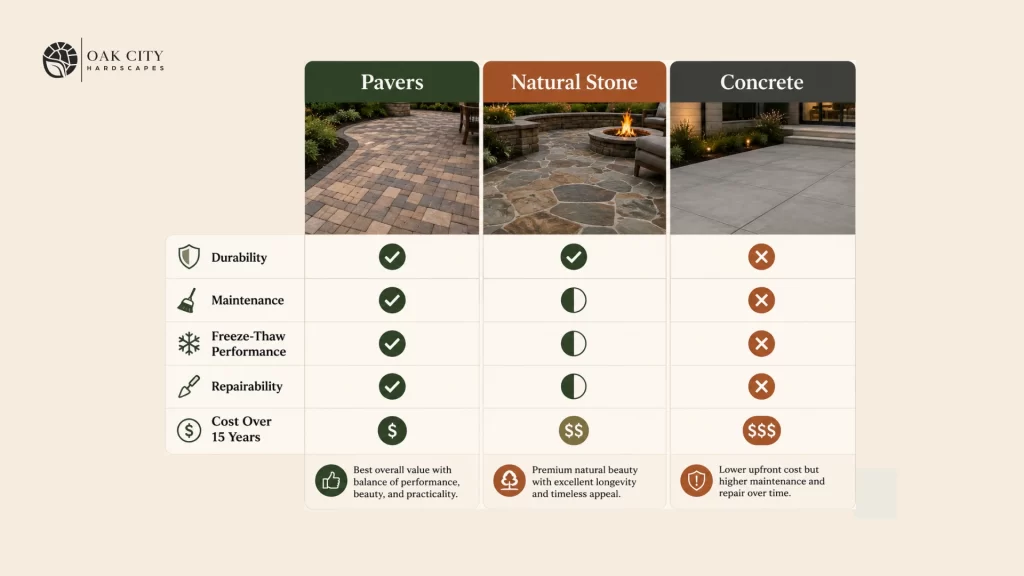
Concrete pavers are the most practical hardscape material for most Raleigh patio projects. They come in dozens of shapes, sizes, and colors. They handle freeze-thaw cycles well because each paver moves independently. When the ground shifts, individual pieces flex rather than the whole surface cracking.
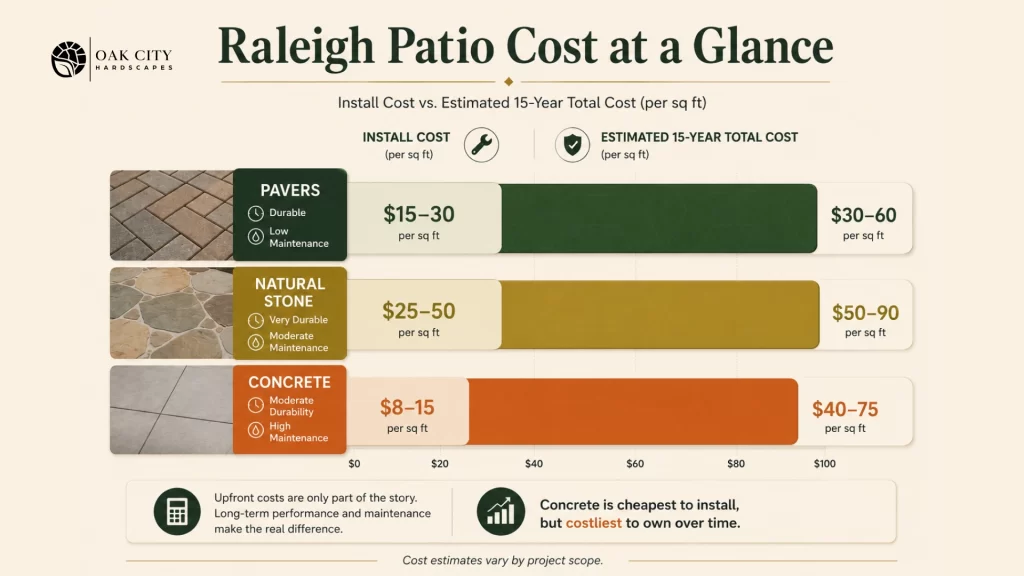
Cost range: $15 to $30 per square foot installed, depending on paver type and project complexity.
Lifespan: 25 to 50 years with basic maintenance. Individual pavers can be replaced without tearing out the whole patio.
Maintenance: Annual re-sanding of joints. Occasional sealing. Low effort, low cost.
The reason pavers dominate Raleigh installs is simple: they are forgiving. If a tree root shifts your base or a vehicle rolls over the edge, you replace three pavers, not your entire patio.
Homeowners comparing patio options alongside deck installations in Raleigh often find that pavers offer the best continuity between indoor and outdoor flooring styles.
Natural Stone: High-End, High Maintenance
Slate, travertine, bluestone, flagstone. Natural stone looks incredible. No argument there.
The problem is that natural stone is porous. In Raleigh’s humidity and rain, unsealed stone absorbs moisture. That moisture freezes in winter, expands, and chips the surface. Most natural stone patios in this climate need sealing every one to three years to prevent surface degradation.
Cost range: $25 to $50 per square foot installed.
Lifespan: Can last for decades with proper maintenance. Drops significantly without regular sealing.
Maintenance: High. Annual or biannual sealing, moss and mildew treatment, and leveling as needed.
Natural stone works well in covered outdoor living areas or under pergola structures where it is protected from direct rain and temperature swings. Fully exposed patio applications in Raleigh require more commitment than most homeowners want to give. If you are planning a custom outdoor living space with covered sections, stone can be a smart design choice for those protected zones.
Per the Interlocking Concrete Pavement Institute, natural stone requires more active maintenance than concrete pavers in climates with freeze-thaw cycles, which positions it as a premium but higher-maintenance choice.
Concrete: Cheapest Upfront, Costliest Over Time
Poured concrete is the least expensive patio surface to install. It is also the one that causes the most problems in North Carolina over time.
Poured concrete slabs crack. Not if, when. The ground beneath Raleigh homes shifts with seasonal moisture changes. Those shifts translate directly into surface cracks. A cracked concrete patio is difficult and expensive to repair because the slab is a single unit.
Cost range: $8 to $15 per square foot installed.
Lifespan: 10 to 20 years before significant cracking and repair costs.
Maintenance: Low initially, then high. Once cracking starts, options are limited to patching (which shows) or full replacement.
Stamped concrete tries to close the gap between plain concrete and pavers by adding texture and pattern. It looks better at install. But the sealant wears off, the color fades, and the cracking issue remains. In Raleigh’s climate, stamped concrete still carries the same structural vulnerabilities as standard poured concrete.
The lower upfront cost almost always gets erased by repair and replacement costs within 10 to 15 years.
The Hidden Cost No One Talks About
Every material comparison focuses on the installation price. Not enough focus goes on base preparation.
The quality of your patio base determines how long any surface lasts. A paver or stone patio installed on a poorly compacted base will shift, sink, and require repairs regardless of the quality of the surface material.
In Raleigh’s clay-heavy soil, base preparation is not a shortcut item. Proper excavation, appropriate gravel depth, and proper compaction add to installation costs but cut years of repair costs. A patio built on a proper base by experienced installers is a completely different product from one rushed through to meet a low quote.
This is where contractor selection matters as much as material selection. When Oak City Hardscapes designs a custom patio, base prep follows the same standard on every project, which is why every inspection passes the first time.
Which Material Fits Which Project
Not every patio is the same. Here is a direct guide:
- Fully exposed patio, Raleigh climate: Concrete pavers. Every time.
- Covered outdoor living area or screened porch surround: Natural stone works here. Less exposure means less moisture intrusion.
- Budget-driven project, shorter timeline: Standard concrete if the budget is fixed, but plan for repair costs within a decade.
- Pool surrounds: Textured pavers or travertine. A non-slip surface is a priority. Learn more about pool surround and retaining wall options.
- Walkways and pathways: Pavers or flagstone set in gravel. Both handle foot traffic and drainage well.
The Brick Industry Association notes that interlocking pavers outperform poured concrete in frost-susceptible climates because the modular system accommodates ground movement without structural failure.
For homeowners also considering a deck addition alongside a patio, the two projects work best when designed together. Material choices on the patio influence how the deck connects visually and structurally.
Why Raleigh Homeowners Choose Oak City for Patio and Hardscape Work
When it comes to patio installation in Raleigh, most contractors will quote you a material and a price. Oak City Hardscapes does it differently. Co-founders Max Laing and Grayson Boyd assess the specific soil conditions, drainage patterns, and sun exposure of your yard before any material recommendation is made. That is how you end up with a patio that performs at year ten, not just year one. For a project you are spending $10,000 to $30,000 on, that distinction matters.
The team installs concrete paver patios, natural stone surfaces, and stamped decorative concrete across Raleigh, Apex, Cary, Holly Springs, and Durham. If your yard has a slope or erosion challenges, Oak City also builds custom retaining walls that integrate structurally and visually with the patio design. For homeowners who want to extend the project into walkways or paver driveways, those are handled in-house as well. Every project is custom-designed before contracts are signed. Permits and inspections are managed by Oak City. Every inspection has passed the first time.
Max and Grayson are on every project. Not just at the start. Not just at handoff. Through the build. That owner-led accountability is what Raleigh homeowners with $500K to $1M+ homes are actually paying for when they choose a premium local contractor over a franchise crew.
FAQs
What are hardscape materials?
Hardscape materials are the non-living elements used in outdoor spaces like patios, walkways, retaining walls, and fire pits. Common options include pavers, natural stone, concrete, and gravel.
What is the best hardscape material for a Raleigh patio?
Concrete pavers are one of the strongest options for Raleigh’s climate because they handle ground movement and seasonal changes better than solid concrete slabs.
What is the cheapest hardscape option?
Poured concrete usually has the lowest upfront cost. However, long-term repairs and cracking can make it more expensive over time.
Is gravel considered a hardscape material?
Yes. Gravel is commonly used for walkways, drainage areas, and decorative borders, especially when paired with pavers or stepping stones.
How much does a paver patio cost in Raleigh?
Pricing depends on size, material, and design complexity. Most paver patios fall within a mid-range investment compared to other outdoor upgrades.
Does natural stone hold up in Raleigh’s climate?
Yes, but it needs regular sealing and maintenance. Moisture and freeze-thaw cycles can wear down untreated stone over time.
Do I need a permit for a patio in Raleigh?
Some patio projects require permits depending on size, structures, and retaining walls. Most professional contractors manage the permitting process directly.
Conclusion
The best hardscape material for your Raleigh patio is the one that fits your exposure, your use, and your realistic maintenance commitment. Pavers are the practical choice for most fully exposed patios in this climate. Natural stone earns its place in covered or partially sheltered designs. Concrete makes sense when budget is the primary constraint, with long-term repair realities in mind.
Get a quote before assuming what you can afford. The difference between a paver patio and a concrete slab in long-term cost is often narrower than people expect once repairs are factored in.
Key Takeaways
- Concrete pavers are the most durable and lowest-maintenance choice for exposed patios in Raleigh’s climate
- Natural stone is a premium option best suited to covered or sheltered outdoor living areas
- Poured concrete has the lowest upfront cost but the highest long-term repair risk in North Carolina
- Raleigh’s 12 to 15 annual freeze-thaw cycles are the most important environmental factor in material selection
- Base preparation quality matters as much as the surface material chosen
- Individual pavers can be replaced without full patio demolition, making them the most repair-friendly option
- Stamped concrete shares the same structural vulnerabilities as standard poured concrete, despite better aesthetics
- Maintenance costs should factor into the total project budget, not just the install price
- Material choice should match the actual exposure and use of the specific outdoor space
- Hiring an owner-led contractor who manages permits and site prep reduces long-term risk significantly
Ready to figure out which hardscape material is right for your Raleigh home?Book a free consultation with Oak City Hardscapes to get a custom patio recommendation tailored to your space, budget, and long-term goals.