
You finally decided to do it. A proper outdoor space. Somewhere to actually use your backyard instead of just mowing it every two weeks and calling it a day.
Then you asked for a quote. And suddenly the number on the screen felt less like a patio and more like a second car.
Here is the thing: patio pricing in Raleigh is not random. It follows a logic. And once you understand that logic, the number stops feeling intimidating and starts making sense. This guide breaks it all down by material, size, and real-world budget so you know exactly what you are getting into before anyone touches your yard.
What Actually Drives Patio Costs in Raleigh
Before anyone throws a number at you, there are four things that genuinely move the needle on what you pay.
Material choice is the biggest lever. Concrete and concrete pavers sit at opposite ends of the price spectrum from natural stone. Choosing between them is the single decision that can swing your total by thousands.
Size is obvious but worth noting: a 200 sq ft patio and a 500 sq ft patio are not priced proportionally. Larger projects sometimes get better per-square-foot rates because setup costs are fixed, but custom cuts, drainage, and access issues tend to pile up as the scope grows.
Site conditions matter more in Raleigh than most homeowners expect. The Triangle’s clay-heavy Piedmont soil drains poorly. Raleigh’s humid summers and occasional winter freezes create freeze-thaw cycles that destroy a poorly prepared base. A proper compacted aggregate base is not optional here. It is the difference between a patio that lasts 20 years and one that shifts and cracks in five.
Complexity adds up fast. A clean rectangle is the cheapest shape to build. Curves, multiple levels, built-in fire pits, and custom walkways and pavers all require more labor, more cuts, and more time. If your vision includes something more ambitious than a flat square, plan for it in your budget from the start.
Price Per Square Foot by Material
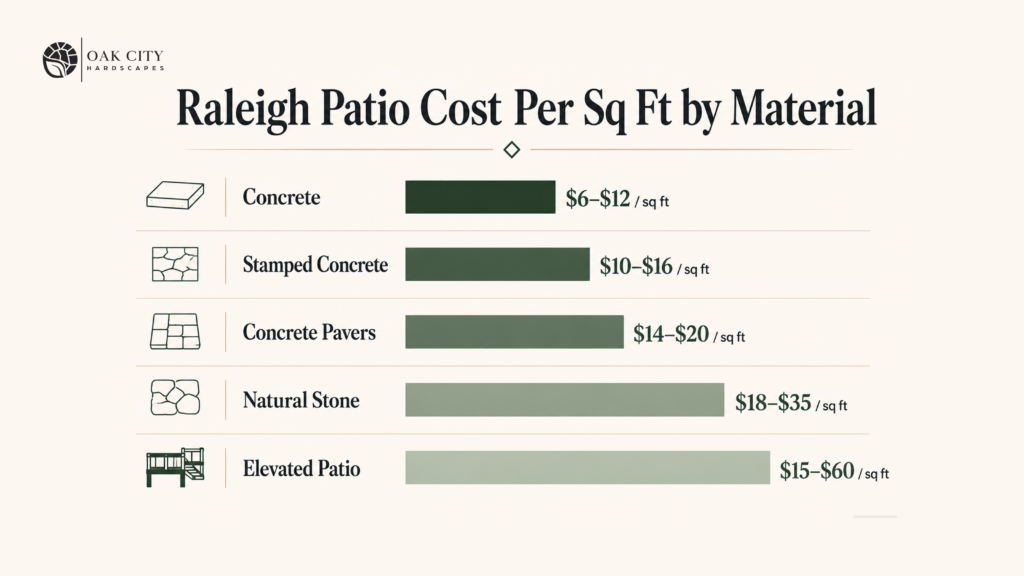
This is where most people want to skip straight to. Here is a clean breakdown of what materials actually cost in the Raleigh market.
Concrete: $6 to $12 per sq ft
Concrete is the dominant choice in the Triangle for a reason. It is cost-effective, durable enough to handle NC’s hot, humid summers and occasional freezes, and low maintenance once sealed. A basic broom-finished slab sits at the lower end. Stamped concrete with custom patterns runs $10 to $16 per sq ft. If you want the look of stone without the stone price, stamped concrete is worth a serious look.
Concrete Pavers: $14 to $20 per sq ft
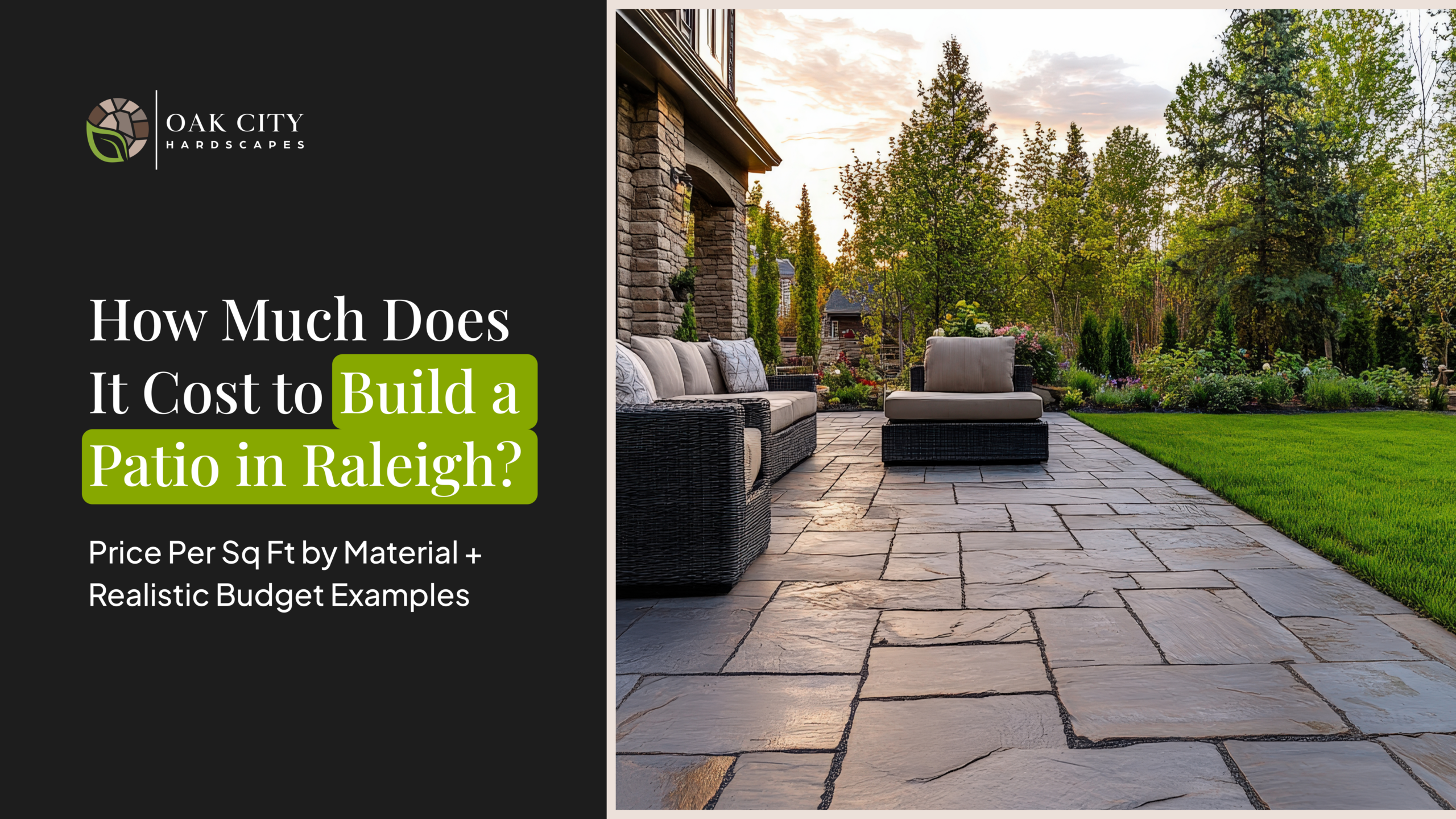
Pavers cost more upfront than a poured slab, but they offer something concrete cannot: repairability. If one paver shifts or cracks, replace it. You do not redo the whole patio. For homeowners planning a long-term custom patio installation, repairability has real value over a 15- to 20-year horizon. Paver patios also handle Raleigh’s drainage challenges well, especially with a properly installed sand-set base.
Natural Stone (Flagstone, Travertine): $18 to $35 per sq ft
This is the premium tier, and the price reflects both the material cost and the labor intensity of working with natural stone. Flagstone is heavier, irregularly shaped, and requires skilled hands to set correctly. Travertine is cooler underfoot, looks exceptional around pools and outdoor kitchens, and has a natural elegance that concrete cannot replicate. If you are building an outdoor kitchen or a full outdoor living area, natural stone elevates the entire space.
Elevated or Multi-Level Patios: $15 to $60 per sq ft
Yes, that range is wide. Elevated patios require structural engineering, footings, and significantly more labor. If your backyard slopes or you want a raised platform with steps and railings, the complexity and cost increase substantially. Get a detailed quote specific to your site conditions before budgeting for one of these.
Realistic Budget Examples for Common Patio Sizes
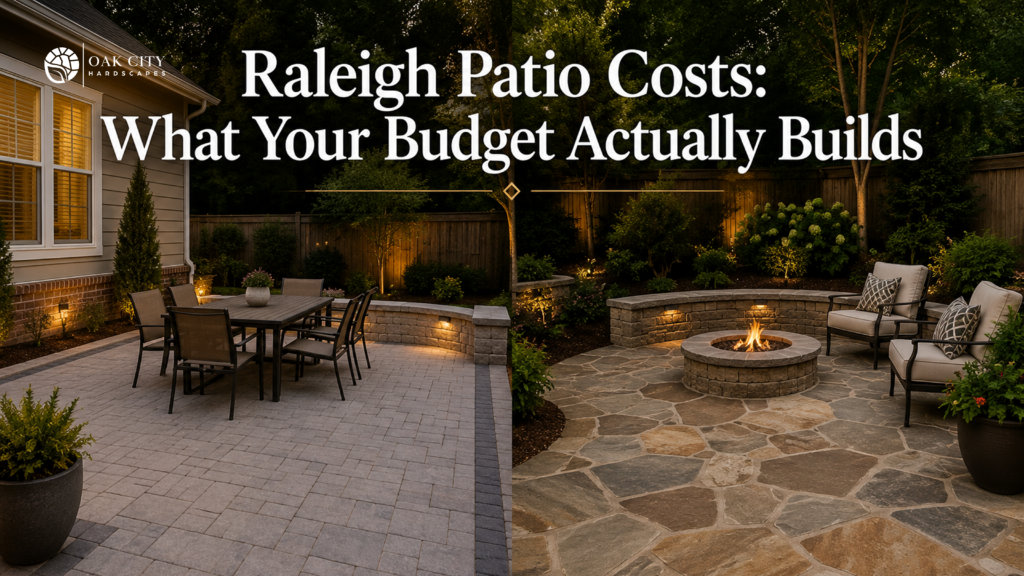
Numbers per square foot are useful, but most homeowners think in terms of total project cost. Here is what real Raleigh patio budgets look like.
Small Patio: 150-200 sq ft. Think a bistro setup or a tight seating area off the back door. Total cost: $1,500 to $4,000, depending on material. Concrete brings this in at the lower end. Pavers push it toward $3,500-$4,000.
Mid-Size Patio: 300 sq ft. This is the sweet spot for most Raleigh homeowners. Enough room for a dining set, a grill station, and actual space to move around. Total cost: $3,000 to $7,500. At $14 to $17 per sq ft in pavers, a 300 sq ft patio lands around $4,200 to $5,100. Natural stone of the same size runs $5,400 to $10,500.
Large Patio: 500 sq ft or more. This is where you are building a genuine outdoor room. Enough for entertaining, a fire pit zone, maybe a pergola. Total cost: $7,500 to $17,500 for pavers. Natural stone at 500 sq ft can exceed $17,000 in fully installed cost. If your vision includes retaining walls or significant grading, add $2,000 to $8,000 to that amount.
The Hidden Costs Most Contractors Forget to Mention
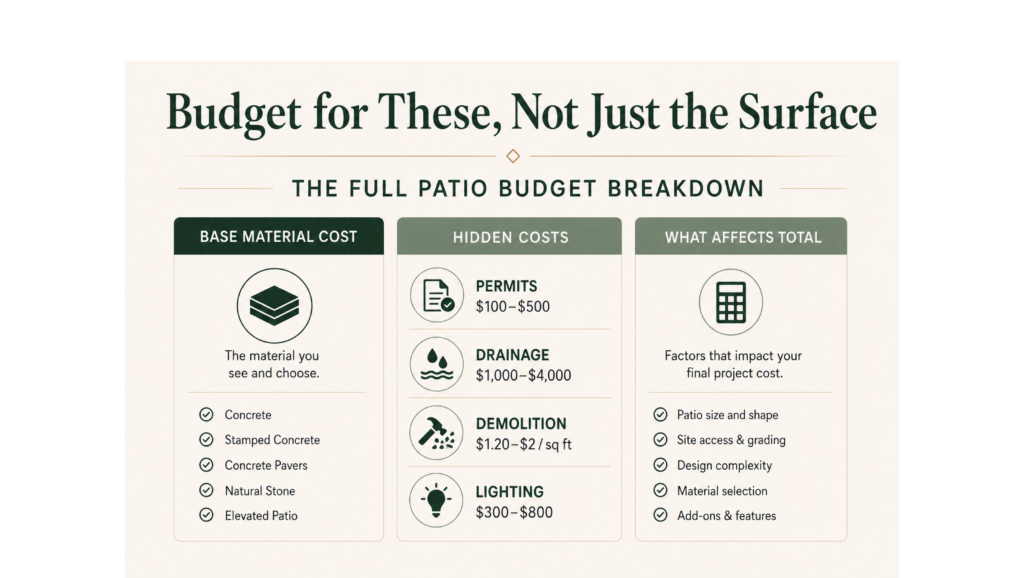
Here is where budgets blow up. Not because the contractor is shady, but because these costs only surface once the project actually starts.
Permits: Raleigh requires permits for patio installations. Budget $100 to $500, depending on project scope. A contractor who handles permits for you and has every inspection pass on the first try is worth paying for. Re-inspections cost money and time.
Site grading and drainage: Raleigh’s clay soil is genuinely bad at draining. If your yard pools after rain, you need drainage work before any surface goes down. A French drain can add $1,000 to $4,000 to the project. Regrading a sloped yard runs $500 to $5,000, depending on how severe the slope is.
Demolition of existing surfaces: Removing an old concrete slab or brick patio adds $1.20 to $2.00 per sq ft to the total. A 300 sq ft demo can add $360 to $600 before new work even begins.
Outdoor lighting: If you want step lights, post lights, or outlet boxes in the patio area, they need to be roughed in before the base is poured. Adding them after means cutting through the finished surface. Budget $300 to $800 for an electrician to run conduit during installation.
HOA review: Many Raleigh and Triangle neighborhoods have architectural review requirements. Some HOAs regulate patio materials, colors, and dimensions. If you live in a Historic District, you may need a Certificate of Appropriateness from the Raleigh Historic Development Commission before permits are even submitted. This adds time. Plan for it.
Does a Patio Actually Add Value to Your Home?
It does, and the numbers are not bad. A professionally installed patio in Raleigh recoup 60% to 75% of its cost at resale, according to local market data. On a $10,000 patio, that is $6,000 to $7,500 reflected in your home’s value.
The catch is proportion. An elaborate patio that consumes most of the backyard can actually work against you with buyers who want green space. Build for the way you live now, and stay proportionate to your lot size. The National Association of Realtors consistently reports outdoor living improvements as among the highest-return projects for Triangle-area homes.
The other factor worth noting: Raleigh’s cost of living is roughly 4% below the national average, which means both materials and labor here can be slightly more affordable than comparable projects in markets like DC or Charlotte. That gap is not huge, but it is real.
Why Oak City Hardscapes Is Raleigh’s Go-To for Custom Patio Builds
If you are a Raleigh homeowner who wants a patio done right the first time, Oak City Hardscapes is the call to make. Co-founders Max Laing and Grayson Boyd bring a combined decade of experience in commercial concrete, paving, and general contracting to every project. This is not a crew that shows up, pours concrete, and moves on. They are personally on every project, which means the standard stays consistent from the first shovel to the final seal.
Oak City handles everything that makes patio builds in Raleigh complicated, including permits, inspections, and site-specific drainage challenges. Every inspection they have ever submitted has passed on the first try. They provide architectural drawings before contracts are signed so you can see exactly what you are getting before anything is built. Their custom patio design and installation service covers concrete, pavers, and natural stone, with full coordination of walkways, fire pits, retaining walls, and outdoor living additions. If the vision includes a full outdoor living space with an outdoor kitchen or screened porch, they build that too.
Theresa, a Raleigh homeowner, put it well: “Dependable, efficient, and quality work at competitive prices. Hidden gem if you are looking for local small business hardscape options.” That is the kind of thing people say when a contractor treats their project like it matters.
FAQs
Q: How much does a basic concrete patio cost in Raleigh?
A basic concrete slab patio in Raleigh runs $6 to $12 per sq ft installed. A 300 sq ft patio lands around $1,800 to $3,600 for a standard finish. Stamped concrete adds cost but dramatically improves the visual result.
Q: Do I need a permit to build a patio in Raleigh?
Yes. Most patio installations require a permit from Raleigh Planning and Development. Permit fees typically range from $100 to $500, depending on project scope and value.
Q: Are pavers worth the extra cost over concrete?
For most homeowners planning to stay in their home long-term, yes. Pavers allow you to replace individual units rather than resurfacing the entire patio when damage occurs. They also handle Raleigh’s drainage and freeze-thaw cycles well when properly installed.
Q: How long does it take to build a patio in Raleigh?
A standard patio takes 3 to 7 days for installation once permits are approved. More complex projects with grading, drainage, or multi-level designs can take 1 to 3 weeks. Permit timelines vary by season and project type.
Q: What patio material holds up best in Raleigh’s climate?
Concrete pavers and sealed concrete both perform well in Raleigh’s humid subtropical climate. Natural stone requires sealing every 18 to 36 months to prevent staining. A properly compacted base is the most critical factor regardless of material choice.
Q: How much does soil grading add to a patio project?
Regrading a moderately sloped Raleigh yard adds $500 to $5,000, depending on the severity. Properties with significant drainage issues or clay-heavy soil may also need a French drain, which adds $1,000 to $4,000 to grading costs.
Conclusion
Patio pricing in Raleigh is not a mystery. Concrete runs $6 to $12 per sq ft. Pavers run $14 to $20. Natural stone costs $18 to $35. The real variables are your site, your soil, your HOA, and how much complexity your design adds. Budget for the hidden costs, plan for permits, and pick a contractor who has actually done this in the Triangle, not just somewhere in the general Southeast.
Book a free consultation with Oak City Hardscapes and get a realistic quote built around your actual yard.
Key Takeaways
- Concrete patio installation in Raleigh runs $6 to $12 per sq ft; stamped concrete adds $4 to $6 per sq ft
- Concrete pavers cost $14 to $20 per sq ft installed and offer better long-term repairability than poured slabs
- Natural stone and flagstone run $18 to $35 per sq ft and perform best when properly sealed annually
- Labor accounts for 40% to 60% of total patio cost in Raleigh, regardless of material
- Raleigh permits for patio installation cost $100 to $500 and are required before work begins
- Clay soil and poor drainage are Raleigh-specific problems that can add $1,000 to $5,000 in site prep costs
- A well-built Raleigh patio returns 60% to 75% of its cost at resale
- HOA architectural review is required before permitting in many Raleigh and Triangle neighborhoods
- Hidden costs such as demolition, drainage, and outdoor lighting frequently add 15% to 25% to the base estimate
- Picking a contractor who handles permits, passes inspections first time, and provides design drawings before contracts is worth every dollar
Ready to build a patio that actually lasts? Book a free consultation with Oak City Hardscapes and get a quote built around your specific yard, not a generic estimate.