
Picture this. It is a Saturday evening in Raleigh. You are standing in your backyard, drink in hand, staring at the same patch of grass you have stared at for three years. You have pinned twelve patios on Pinterest. You have watched four YouTube videos about pavers. You have mentally placed a fire pit in that corner approximately forty times.
And yet, somehow, nothing has happened.
Not because you do not want it. Because the moment you started Googling “patio construction company near me,” you fell into a rabbit hole of vague quotes, confusing timelines, and contractors who either never called back or showed up to give you a number that felt made up.
Here is everything you actually need to know before any of that happens again.
Table of Contents
- What the Build Process Actually Looks Like, Step by Step
- How Long Does Patio Construction Take in Raleigh?
- Do You Need a Permit for a Patio in Raleigh?
- What Patio Construction Costs in Raleigh
- Pavers vs. Concrete: The Decision That Changes Everything
- How to Compare Quotes Without Getting Burned
- Why Raleigh Homeowners Choose Oak City Hardscapes for Patio Construction
- Conclusion
- FAQs
- Key Takeaways
What the Build Process Actually Looks Like, Step by Step
Most contractors hand you a number on a napkin and call it a proposal.
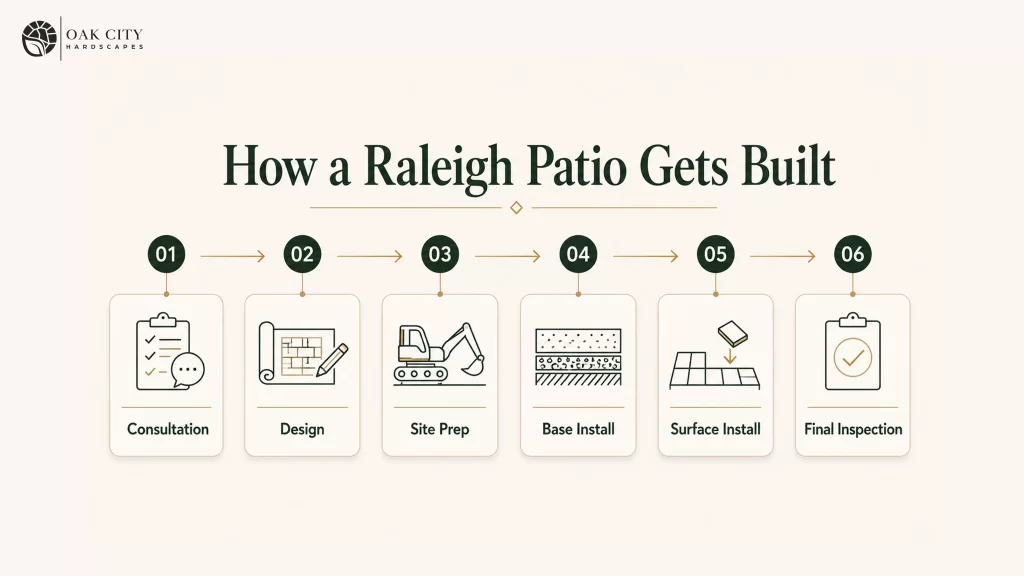
What actually happens on a properly run patio project looks nothing like that. Here is the real sequence, the part nobody explains until you are already mid-construction, wondering why your yard looks like a crater.
Consultation and site evaluation. A contractor worth hiring comes out. Walks the space. Asks how you actually use your backyard, not just what it should look like. Talks through materials, drainage, and realistic expectations. This is not a phone call. It is not an estimate submitted through a contact form. It is a real, on-site conversation with someone who understands that your backyard is not a generic problem.
Custom design and material selection. Here is where it gets exciting. Layout, material, finish, add-ons. Fire pit in the corner? Retaining wall along the slope? Outdoor kitchen hookup for later? This is the stage where your rough idea starts to take shape as an actual plan. At Oak City, architectural drawings are provided before contracts are signed, so you are not signing off on something you can only imagine in your head.
Site preparation. And here is where most homeowners completely check out of the process, which is exactly the wrong moment to do so. Grading. Excavation. Drainage planning. This is the unsexy work that determines whether your patio is still level in five years or slowly becoming a pond. Raleigh’s clay-heavy soil shifts. Water has to go somewhere. A contractor who rushes site prep is building you a beautiful problem.
Base installation. A compacted gravel base is installed before any surface material is applied. This is the foundation. Skip it, rush it, or cheap out on it, and you will be relaying pavers in three years, wondering what went wrong.
Surface installation. This is the part you have been waiting for. Pavers, concrete, natural stone, whatever you choose, get laid. The backyard starts to look like a Pinterest board. This is the good part.
Finishing and cleanup. Edging, polymeric sand for pavers, sealing where applicable, and the crew leaves your yard cleaner than they found it. Not close to clean. Actually clean.
Final inspection and walkthrough. Every project Oak City builds passes inspection on the first visit. Not eventually. First time. See how Oak City runs the full patio and hardscape process. That detail matters more than it sounds when you realize how many Raleigh projects do not.
How Long Does Patio Construction Take in Raleigh?
Real timelines, not the optimistic ones contractors quote when they want the job:
- Small patio (under 200 sq ft): 2 to 4 days of active construction
- Mid-size patio (200 to 400 sq ft): 4 to 7 days
- Large or complex patio (400+ sq ft, multi-level, fire pit, retaining wall): 1 to 3 weeks
Then add permit processing time. Material lead times. The week it rained every single afternoon because Raleigh summers are relentless. Experienced contractors build a buffer into their schedules. The ones who quote you two days for a 400-square-foot project are either skipping steps or about to teach you something expensive.
Total project timeline from first call to finished patio: typically 3 to 8 weeks. Not because the work takes that long. Because doing it correctly takes that long.
Do You Need a Permit for a Patio in Raleigh?
Here is where things get specific to Raleigh in a way that surprises many homeowners.
Ground-level patios generally do not require a building permit from the City of Raleigh Development Services. Generally. The exceptions are where people get caught:
- Patios attached to the home’s structure
- Projects with a pergola, roof, or any covered element over the patio
- Retaining walls above a certain height
- Work near easements or property lines
- Your HOA, which operates entirely separately from the city and answers to no one
That last one. If you live in Apex, Cary, or Holly Springs, there is a strong chance your HOA has opinions about your patio. Material restrictions. Finish requirements. Color guidelines exist for reasons nobody can fully explain. HOA approval must be obtained before construction begins, regardless of what the city says.
A contractor who skips the permit conversation has not done enough work in the Triangle. Or they are hoping you do not notice until it is your problem. Always ask. Always confirm. Get it in writing.
What Patio Construction Costs in Raleigh
You want a number. Here are real ones.
- Concrete patio: $8 to $18 per square foot installed. A 20×20 concrete patio runs approximately $3,200 to $7,200, depending on finish and site conditions.
- Paver patio: $15 to $30 per square foot installed. A 20×20 paver patio typically falls between $6,000 and $12,000.
- Natural stone patio: $25 to $50-plus per square foot. Premium material, premium result, and a look that does not come in a kit.
According to HomeAdvisor’s national patio cost data, the average homeowner spends around $3,900. Raleigh mid-range projects with quality materials and proper prep run higher. A sloped yard that needs regrading, a fire pit, and a connecting walkway is not a $3,900 project. It is also not the same project as a flat rectangular slab in a backyard that drains perfectly.
The number changes based on what the ground is doing, what you are building, and how much the contractor actually includes in their quote. Which brings us to the decision that shapes all of this.
Pavers vs. Concrete: The Decision That Changes Everything
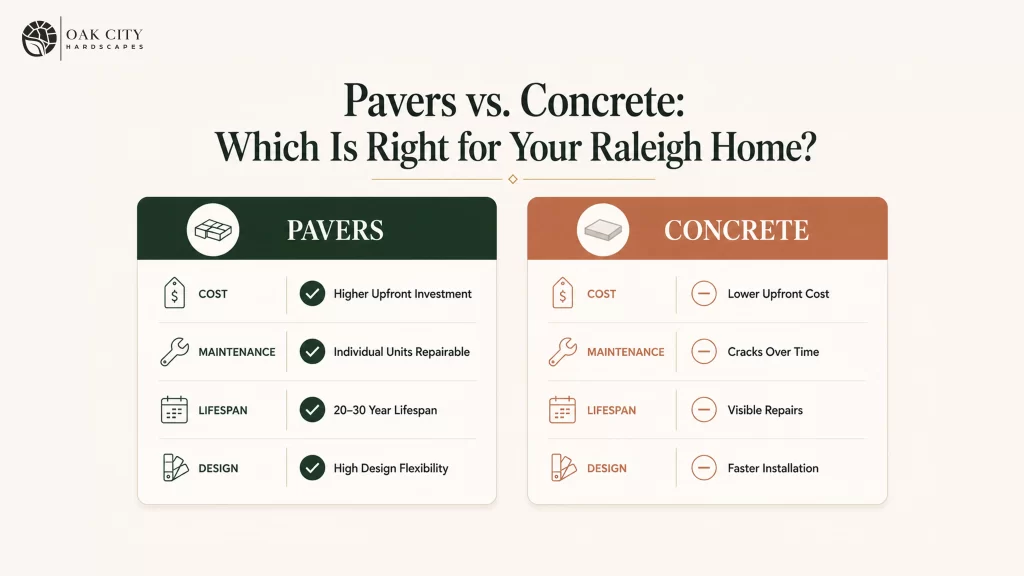
Concrete is cheaper. That part is true.
Here is what else is true. Raleigh’s soil is clay-heavy. Clay shifts. Concrete cracks. Once concrete cracks, the repair is visible. You are not patching it invisibly. And full replacement is not a weekend project. It is several thousand dollars and a crew tearing out what you already paid for.
Pavers cost more upfront. Individual pavers can be lifted and relaid if something shifts underneath or a utility line needs access later. They offer more design flexibility, age better with basic maintenance, and according to the Interlocking Concrete Pavement Institute, properly installed paver systems last 20 to 30 years with minimal upkeep.
The honest version: concrete makes sense for lower-budget projects and rental properties where you are not planning to stay long-term. Pavers make sense for homeowners who plan to be there for a decade or more and want a result that actually holds up.
Neither is wrong. The wrong call is picking one without thinking past the initial quote.
If you want to see what both materials actually look like on finished Raleigh projects, browse Oak City’s patio and hardscape portfolio. Real projects, real results, same conditions you are working with.
How to Compare Quotes Without Getting Burned
You send out three requests. Three quotes come back. $6,000. $9,500. $14,000.
Your instinct says go with the middle one. It feels safe. Not too cheap, not too expensive. But here is what that instinct is missing: those three quotes might not be for the same project. At all.
Scope of work. Does the quote include base prep, excavation, and drainage planning? Some lower quotes quietly strip these out. When you ask specifically, the answer tells you everything.
Material specified. Pavers are not pavers. Ask for the exact product, brand, and grade. A quote that says “pavers” without a spec is a quote for whatever is cheapest that week.
Insurance. Liability coverage and workers’ comp. Ask for proof of both. If a crew member gets hurt on your property and there is no coverage, you find out about it in a very bad way.
Permit handling. If a permit is required, who pulls it? If the answer is you, ask why.
Who shows up. The person who gives you the quote and the crew that builds your patio are sometimes two completely different situations. Ask directly.
One homeowner saves $2,000 upfront and spends $4,000 three years later fixing what the cheap quote did not include. This happens enough that it is not a cautionary tale. It is a pattern.
Why Raleigh Homeowners Choose Oak City Hardscapes for Patio Construction
Most patio construction companies in Raleigh are selling you a project.
Oak City Hardscapes is run by Max Laing and Grayson Boyd, two co-founders who built the company on a decade of combined experience in paving, commercial concrete, and general contracting. They are not managing from an office, while a rotating crew shows up at your yard. They are on-site. Every project reflects its personal standard, which means the accountability you see at the first consultation is the same accountability that shows up on the last day.
Every inspection Oak City has passed on the first visit. No back-and-forth. No failed walkthroughs. Architectural drawings are provided before contracts are signed, so you are approving a real plan, not a verbal description. For homeowners who have been through the contractor experience once already and do not want a repeat, this is the difference. Request a free patio consultation here.
And if your project is more than a patio slab, Oak City builds the whole thing: retaining walls, fire pits, walkways, pool surrounds, outdoor kitchens. One crew. One standard. No handoffs to a subcontractor you have never met.
FAQs
Q: How much does it cost to build a 20×20 patio in Raleigh?
A 20×20 patio (400 sq ft) in Raleigh typically runs $6,000 to $12,000 for pavers and $3,200 to $7,200 for concrete, depending on site conditions, base prep, and finish. Get a site-specific quote before committing to any number you found online.
Q: Do I need a permit to build a patio in Raleigh, NC?
Ground-level patios generally do not require a city permit, but covered structures, attached builds, and anything in an HOA community may require separate approval. Always confirm with your contractor before construction begins, not after.
Q: How long does patio construction take?
Most mid-size residential patios in Raleigh take 4 to 7 days of active construction. Factor in permitting, material lead times, and weather, and the total project duration typically runs 3 to 6 weeks from the first consultation.
Q: Is it cheaper to lay pavers or pour concrete?
Concrete costs less upfront. Pavers cost more initially, but individual units can be repaired or replaced without tearing out the whole surface. For homes you plan to stay in for 10-plus years, pavers almost always win on long-term value.
Q: What should I look for when comparing patio contractor quotes?
Confirm that base prep, excavation, and drainage are included. Ask for the specific material brand and grade. Verify insurance. Find out who is actually doing the work. Price is not the signal. Scope is.
Q: Can a patio be built in any season in Raleigh?
Yes. Raleigh’s climate supports year-round hardscape construction in most cases. Winter ground conditions can occasionally affect scheduling. Spring and fall are peak seasons, so if you want a summer patio, start the conversation earlier than you think you need to.
Conclusion
Here is the thing about patio construction in Raleigh. The process is not complicated. The decisions are not mysterious. The timeline is predictable when someone who knows what they are doing is running the project.
The problems arise when homeowners pick a contractor based on price alone, skip the permit conversation, or sign a quote that does not specify what is included.
Do not be that homeowner. You have already read this far. You know better now.
Book a free consultation with Oak City Hardscapes.
Key Takeaways
- The opening conversation with a contractor tells you everything; how they ask questions is as important as how they answer yours
- Site prep and base installation are the steps that determine whether your patio lasts three years or thirty
- Ground-level patios in Raleigh usually do not require a city permit, but HOA requirements are a separate conversation entirely
- Raleigh’s clay-heavy soil makes drainage planning non-negotiable, not optional
- A 20×20 paver patio in Raleigh typically runs $6,000 to $12,000 installed, depending on site conditions and design
- Concrete is cheaper upfront; pavers are the better long-term investment for homes you plan to stay in
- Three quotes that look different in price are often three quotes for three different scopes of work
- Always ask who is physically showing up to build the project, not just who sold it to you
- Passed first-time inspections are not the industry standard; they are a signal of who runs a tight process
- The goal is not the cheapest patio, it is the one that still looks right ten years from now