
Most people land on a hardscape company’s website and leave more confused than when they arrived.
Vague service lists. No prices. No process. Just a gallery of pretty pictures and a “get a quote” button.
So here’s the version of this page that actually answers your questions.
What a hardscape company does. What things cost in Raleigh? How long projects take. And what to look for before you hire anyone.
What Does a Hardscape Company Actually Do?
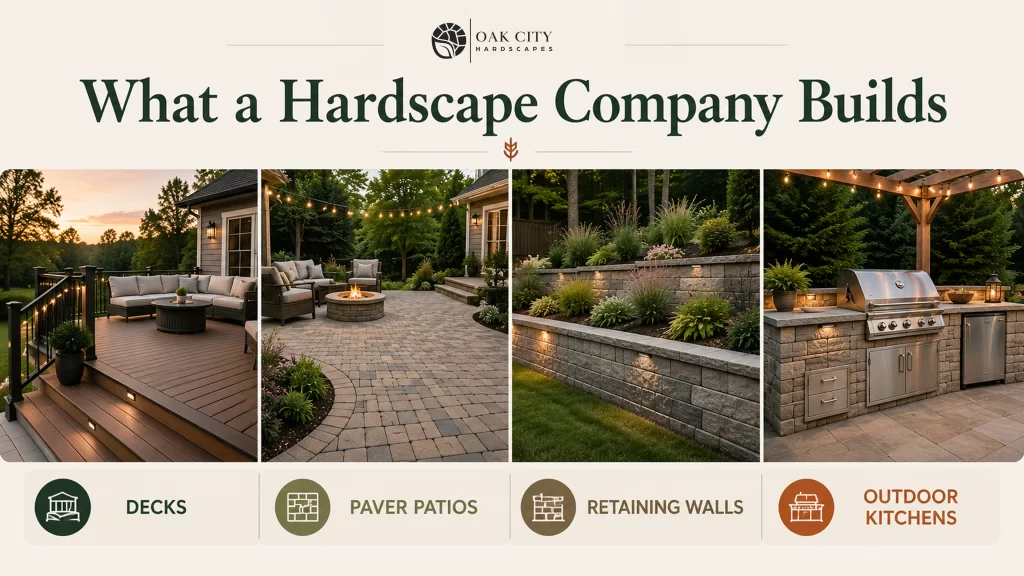
Short answer: They build the permanent, hard-surface elements of your outdoor space.
Decks, patios, retaining walls, outdoor kitchens, fire pits, walkways, pool surrounds. The stuff that takes serious construction skill and doesn’t wash away in the first storm.
Hardscaping is not landscaping. A landscaper plants things. A hardscape company builds things. What makes a good one? They know materials. They pull permits. They design before they dig. And they show up when they say they will.
The People Also Ask data on Google shows homeowners are searching “what does a hardscaping company do” and “how to choose a reputable hardscape contractor” more than anything else. Which tells you most companies aren’t answering these questions clearly.
So here’s the honest version.
The Services That Matter Most for Raleigh Homeowners
Not every hardscape company does everything. Here’s what actually gets requested most in the Raleigh Triangle, and what each involves.
Composite and Wood Decks
Decks are the most-requested hardscaping project in the Triangle right now. If you have a walk-out from your main floor and nowhere to go, a deck can completely change how you use your home.
Composite decks built with TimberTech materials are the current standard for homeowners who want something that lasts. Capped polymer boards resist moisture, staining, and fading in ways that pressure-treated wood simply cannot. The warranty runs up to 50 years. The maintenance is minimal. It costs more upfront and saves money over time.
Wood decks still make sense in certain situations. Lower upfront cost, natural look, easier to modify down the road. But in Raleigh’s humid summers, wood requires consistent upkeep, or it deteriorates faster than you’d expect.
Read the full breakdown in our wood vs. composite vs. PVC guide, or explore our deck services page to see what we build and how we approach each project.
Custom Patios and Pavers
Patios are permanent and ground-level. Pavers, concrete, natural stone. They extend your usable outdoor square footage, connect your home to the yard, and hold up through Raleigh’s freeze-thaw cycles when installed correctly.
What makes a patio project go wrong is usually poor base preparation or drainage. The finished surface is the easy part. The work underneath is what matters.
Retaining Walls
These solve real problems. Sloped yards, erosion, and grade changes near a foundation. A retaining wall is structural, not decorative. It has to be engineered for the load it’s holding.
If you have a yard that slopes dramatically or soil that shifts after heavy rain, a retaining wall project might be a higher priority than it looks.
Outdoor Kitchens, Fire Pits, and Living Areas
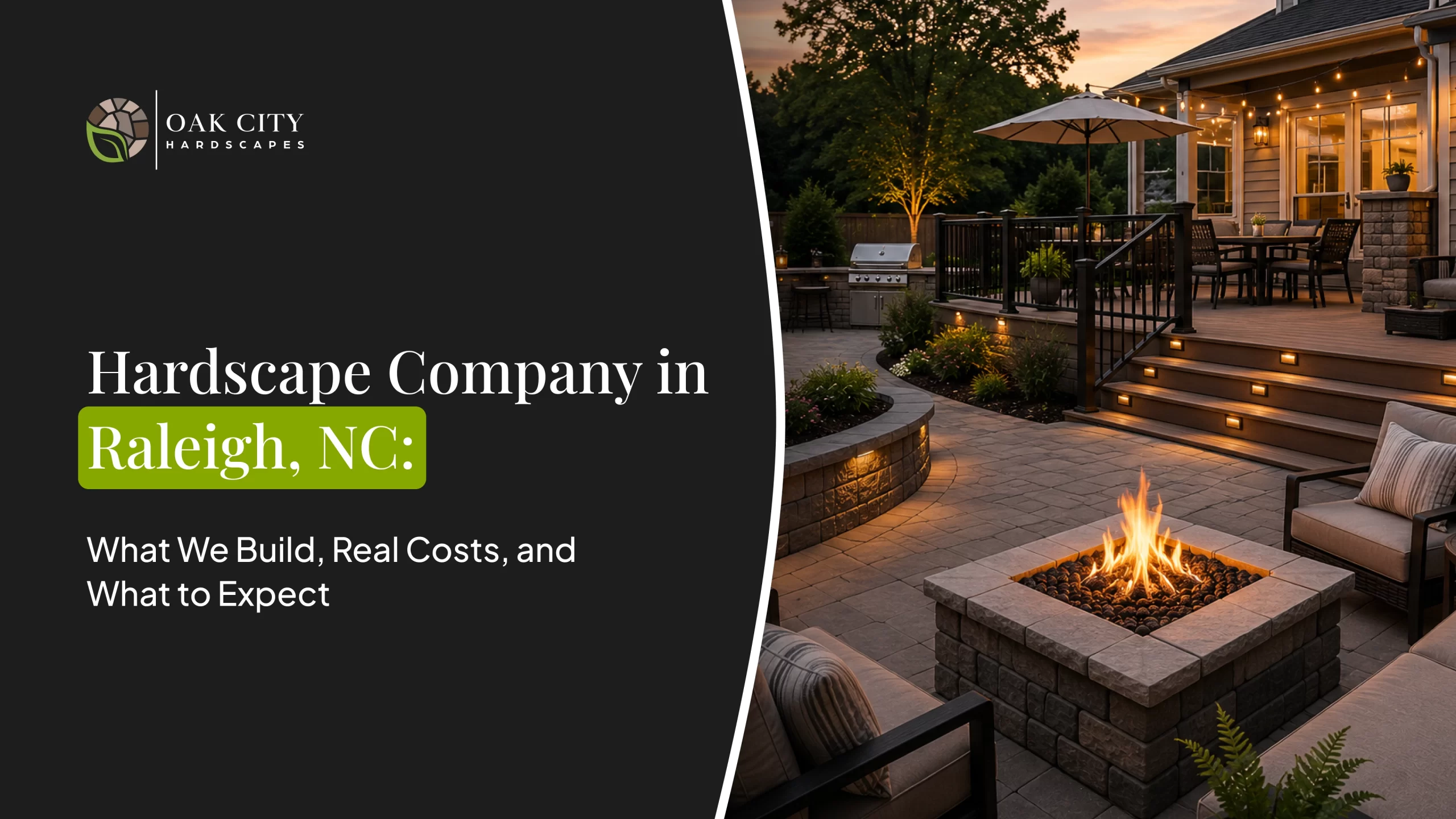
This is where projects get fun. Outdoor kitchens with built-in grills, countertops, and refrigeration. Fire pits and fireplaces. Pergolas. Shade structures.
These projects usually follow a patio or deck build. They’re the add-ons that make the space actually liveable rather than just walkable.
Why Costs Vary More Than You Expect
This is the question everyone has, and most companies avoid.
Let’s talk about it directly.
Composite deck: $25,000 to $60,000+ depending on size, material tier, and complexity. A basic 300 sq ft composite deck on a flat lot, single-level, costs considerably less than a multi-level wraparound with built-in lighting and a screened porch. See the full composite deck cost breakdown for Raleigh.
Paver patio: $8,000 to $30,000+, depending on square footage, material choice, and whether excavation and drainage work is required.
Retaining wall: $5,000 to $25,000+. Block type, wall height, drainage requirements, and load calculations all significantly affect price.
Outdoor kitchen: $15,000 to $50,000+. Built-in appliances, countertop material, electrical and gas rough-in, and footings all add up.
Why the wide ranges? Three reasons.
Site conditions. A flat yard with easy access is a different project than a sloped lot with mature trees and restricted equipment access. You find out what you’re dealing with during site review.
Material grade. Entry-level pavers and premium natural stone are both types of pavers. They do not cost the same. What you pick matters.
Scope creep. Not the bad kind, necessarily. Most homeowners start with a patio and realize they also want a fire pit, lighting, and a pergola once they see the design. Projects expand. Budget accordingly.
According to Raleigh’s permit office, permits are required for most structural outdoor projects, including decks over a certain height and any work affecting drainage. A quality hardscape company handles this for you without making it your problem.
What the Timeline Actually Looks Like
This is where the gaps between expectation and reality tend to appear.
Most hardscape projects in Raleigh run 2 to 8 weeks from permit approval to completion. But permit approval alone can take 2 to 4 weeks, depending on the project type and city workload.
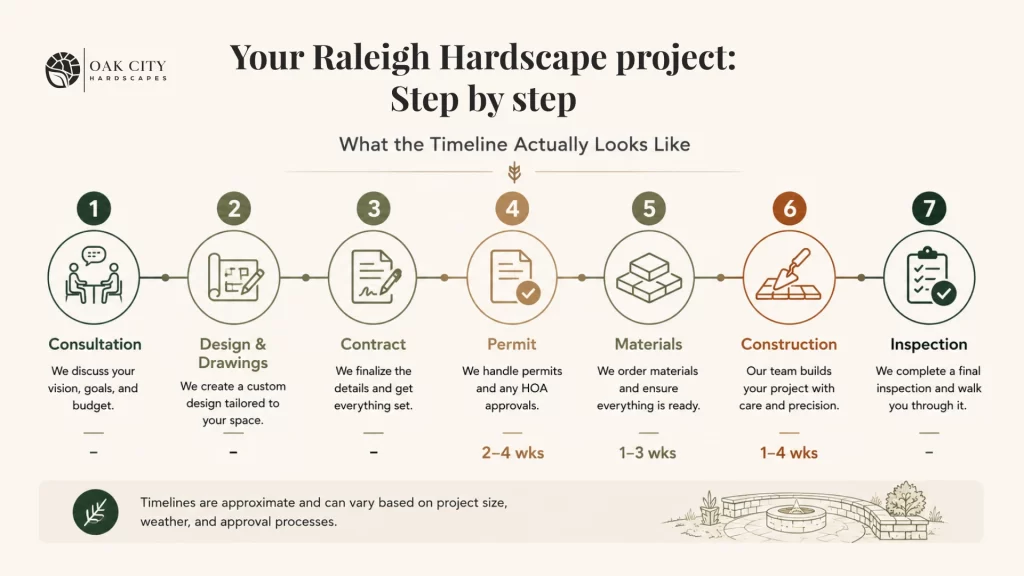
Here’s a realistic sequence:
- Initial consultation and site assessment: 1 session
- Design and architectural drawings: 1 to 2 weeks
- Proposal and contract: a few days
- Permit application and approval: 2 to 4 weeks
- Material lead time: 1 to 3 weeks, depending on the product
- Active construction: 1 to 4 weeks, depending on the scope
- Final inspection: 1 to 3 days
Total from first call to finished project: 2 to 4 months is realistic for a mid-size project. Rushed timelines are usually the ones that produce problems.
One thing worth knowing about Raleigh specifically: the city and surrounding counties have different permit timelines. Apex and Cary sometimes move faster. Durham varies. A contractor who works across the Triangle regularly knows how to manage this. For a detailed look at the process, the composite decking installation guide walks through each phase.
Hardscaping vs. Landscaping: The Difference Worth Knowing
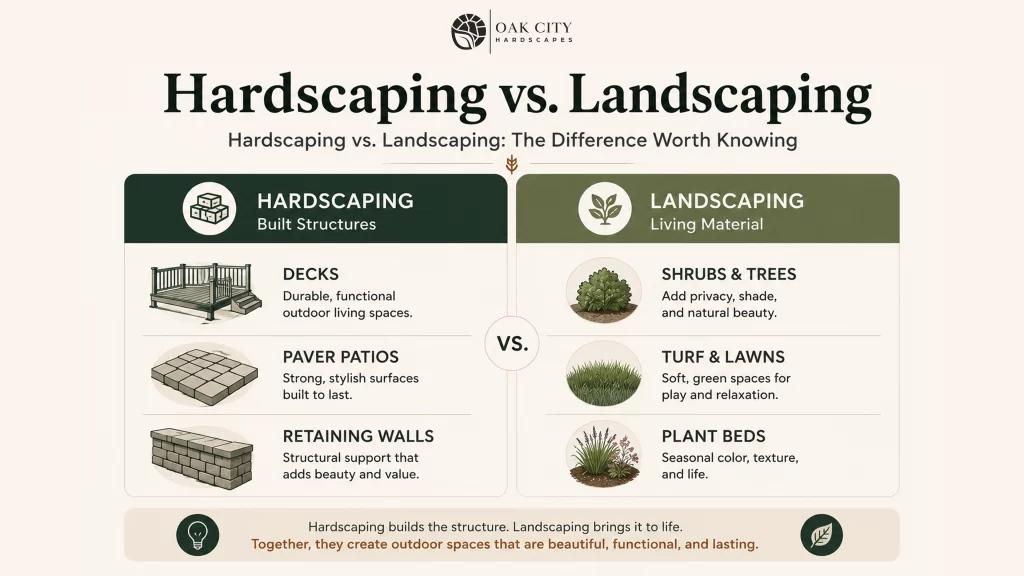
People mix these up constantly.
Hardscaping is a permanent structure. Materials that don’t grow and don’t die. Concrete, stone, pavers, wood, composite boards, steel. The framework of your outdoor space.
Landscaping is everything that grows. Grass, plants, shrubs, trees, and mulch beds. Living material that changes with the seasons.
Most outdoor projects need both. You build the hardscape first, then the landscaper comes in around it. Doing it in reverse causes problems.
Some companies do both. Many specialize in one. Know who you’re hiring before you sign anything. If a company advertises “hardscape and landscaping,” ask specifically what percentage of their work is structural. The answer tells you where their actual expertise lies.
The Raleigh Hardscape Company That Actually Gets It Done Right
If you’re serious about your outdoor space, Oak City Hardscapes is the team Raleigh Triangle homeowners keep coming back to and sending their neighbors to.
Co-founders Max Laing and Grayson Boyd are personally involved in every project. Not managing from an office. On-site. That means permits are pulled without being asked, architectural drawings are in your hands before a contract is ever signed, and every inspection has passed on the first submission. That last detail alone separates Oak City from most of the competition.
The scope of work covers everything a Triangle homeowner actually needs:
Composite and wood decks built with TimberTech materials, with railing options in cable, aluminum, and composite.Custom patios in pavers, natural stone, stamped concrete, and decorative finishes, with drainage and grading handled as part of every install. Retaining walls engineered for slope, load, and long-term drainage, not just looks. Walkways and pavers in stone, brick, concrete, and paver systems built for Raleigh’s climate and daily use. Outdoor kitchens with weatherproof construction, professional-grade appliances, and custom stone finishes, designed for the homeowner who actually uses the space year-round.
One company. One point of contact. No subcontracting surprises.
Book a free consultation with Oak City Hardscapes and see why they’re the team Triangle homeowners trust to get it right the first time.
FAQ
What is a hardscape company?
A hardscape company designs and builds the permanent, hard-surface elements of your outdoor space. Decks, patios, retaining walls, walkways, fire pits, and outdoor kitchens. Anything structural that isn’t plants or turf.
What does a hardscaping company do differently from a landscaper?
A landscaper works with plants and living material. A hardscaping company works with built structures, including concrete, stone, pavers, composite decking, and steel framing. Most full outdoor projects need both, in sequence, with hardscaping first.
What is the average cost of hardscaping in Raleigh?
It depends entirely on the project. A paver patio starts around $8,000 to $15,000 for a basic install. A composite deck runs $25,000 to $60,000+. Outdoor kitchens and full outdoor living areas can reach six figures. Get a site assessment before making budget assumptions.
Why is hardscaping so expensive?
Materials, labor, permits, site prep, and drainage work all factor in. The visible surface is maybe 30% of the job. The other 70% is base preparation, structural framing, permit compliance, and drainage. Cut those corners, and the surface fails within a few years.
Do hardscape projects in Raleigh require permits?
Most structural projects do. Decks above a certain height, any work with structural footings, and projects affecting drainage typically require a permit from the city or county. A good contractor pulls permits and handles inspections. If a company suggests skipping permits to save money, that is a red flag.
How long does a hardscape project take in Raleigh?
From first consultation to completion, plan for 2 to 4 months on a mid-size project. Permit timelines vary by city. Active construction usually takes 1 to 4 weeks, depending on the scope.
How do I choose a reliable hardscape contractor in Raleigh?
Check Google reviews and ask for named references. Ask who specifically will manage your project. Ask if they pull permits and provide architectural drawings before contracts are signed. And compare two or three quotes, not just on price but on what each includes.
Conclusion
A well-built hardscape project does more than improve curb appeal. It changes how you use your home. From composite decks and patios to retaining walls and outdoor living spaces, the right hardscape landscaping company helps you create something functional, durable, and built for long-term value.
In Raleigh, where drainage, grading, permits, and material quality all matter, experience makes a difference. Oak City Hardscapes combines detailed planning, quality craftsmanship, and hands-on project management to build outdoor spaces that look good, function properly, and last for years.
Key Takeaways:
- A hardscaping company builds permanent outdoor structures, including decks, patios, retaining walls, walkways, and outdoor kitchens. Not plants, not turf.
- Hardscaping and landscaping are different trades. Hardscaping always comes first.
- Composite decks in Raleigh run $25,000 to $60,000+. Paver patios start around $8,000. Outdoor kitchens range from $15,000 to $50,000+. Wide ranges exist because site conditions, materials, and project scope all vary significantly.
- Most mid-size hardscape projects in Raleigh take 2 to 4 months from first call to completion, including permit approval time.
- Permits are required for most structural outdoor projects in Raleigh and surrounding counties. A quality contractor handles this without making it your problem.
- The question that tells you the most about a contractor: who specifically is managing your project, and will they be on site every day?