
You want more from your outdoor space.
Not just a basic platform attached to the back of the house. You want something that actually works for how you live. Morning coffee on one side. Dinner with a view from the other. A raised deck that makes use of that sloped yard you’ve been ignoring.
If you’re a Raleigh homeowner considering a wraparound or raised deck, this post is for you. No fluff. Just real design ideas, what they actually cost, and when each one makes sense.
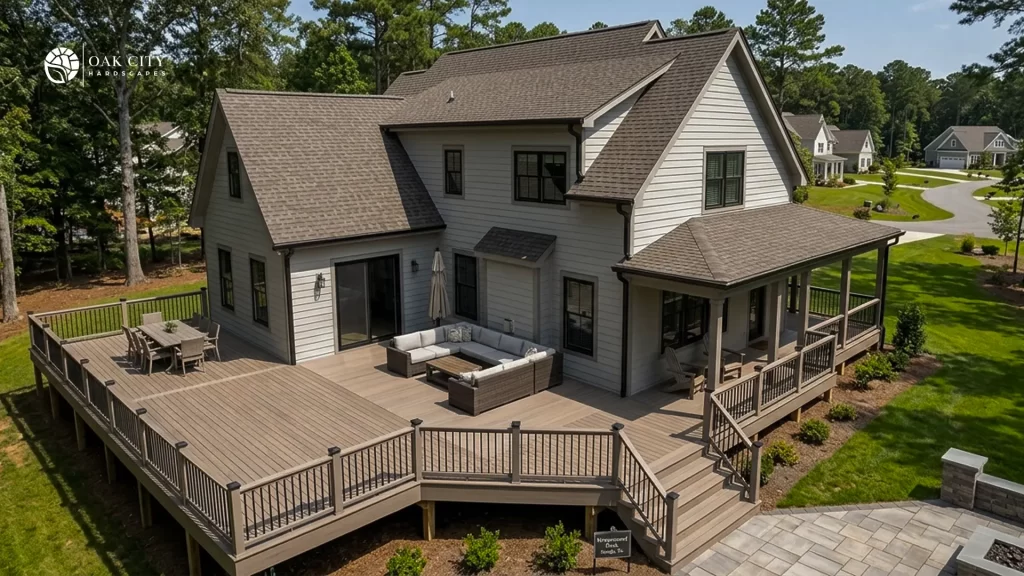
What Is a Wraparound Deck?
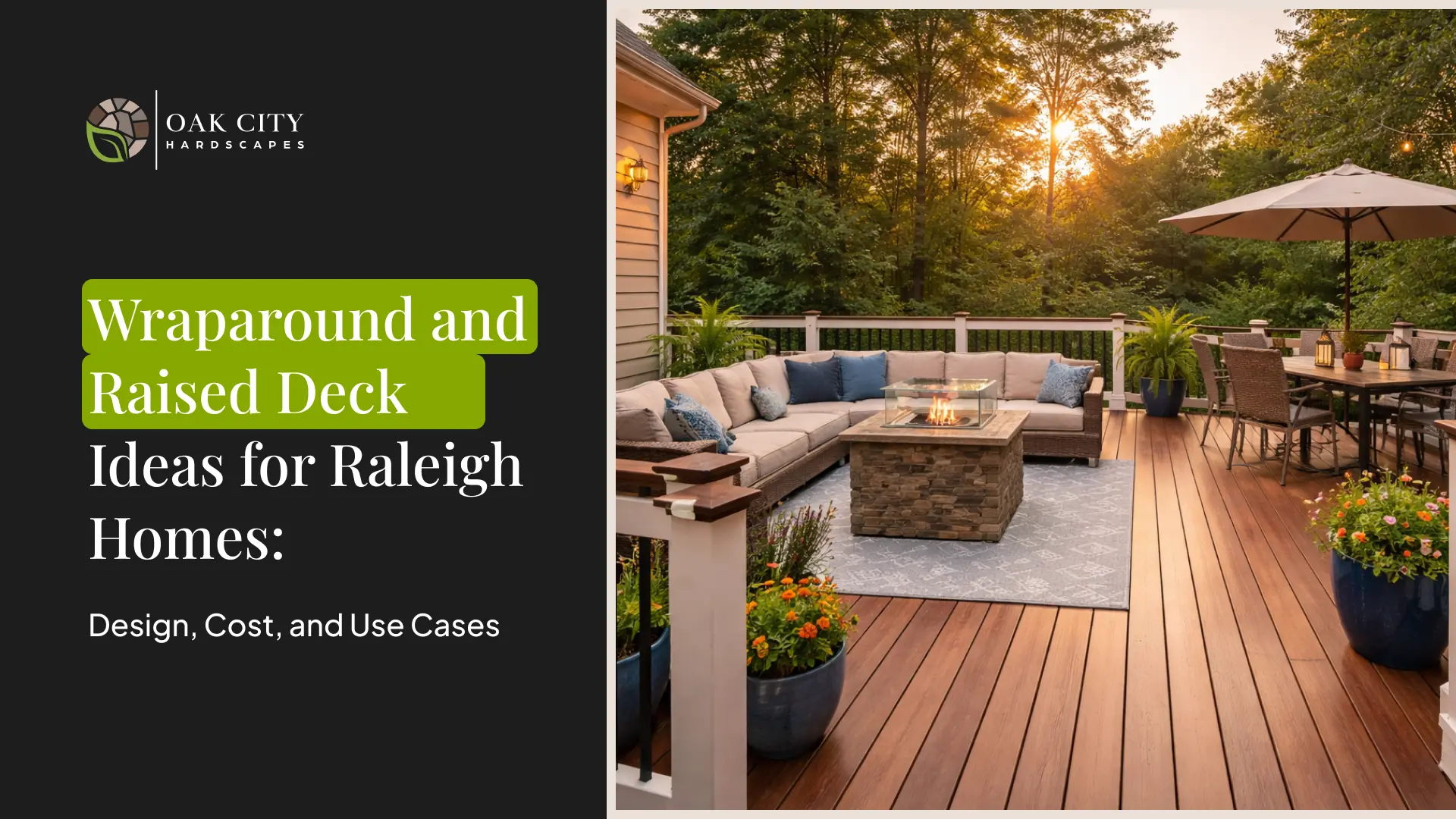
A wraparound deck extends along at least two sides of your home. Sometimes three. It follows the exterior of the house rather than sitting against a single wall.
The result is more usable space, more views, and more flexibility in how you use the deck across different times of day.
A wraparound is not just a bigger deck. It is a different kind of outdoor living. You can have a shaded seating area on the north side and a sun-drenched dining space on the south. The deck works with your house rather than just hanging off the back.
In Raleigh’s climate, where spring and fall mornings are genuinely worth being outside for, that kind of flexibility is put to good use.
What Is a Raised Deck?
A raised deck is built above ground level. How high it depends on your home’s layout and your yard.
Some raised decks are two or three feet off the ground. Others are full second-story structures accessed directly from an upper floor. In between, you’ve got everything from split-level decks to raised platforms that step down to a patio below.
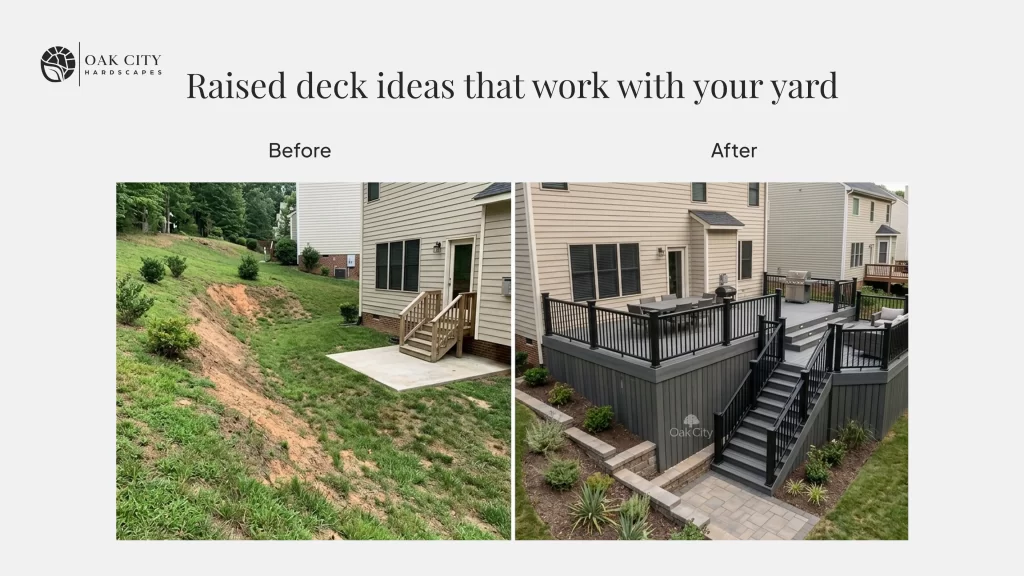
Raised decks are especially useful in Raleigh’s hillier suburban neighborhoods, where backyards in areas like Cary, Holly Springs, and Apex often slope away from the house. Rather than fighting the grade, a raised deck uses it.
Done well, a raised deck makes a sloped yard look intentional. Done poorly, it’s a liability.
That’s why the structure matters as much as the surface.
Wraparound Deck Design Ideas for Raleigh Homes
There is no single wraparound deck layout. The best designs come from understanding how the house sits on the lot, where the sun moves, and how the family actually uses outdoor space.
Here are a few design directions that work well in the Triangle.
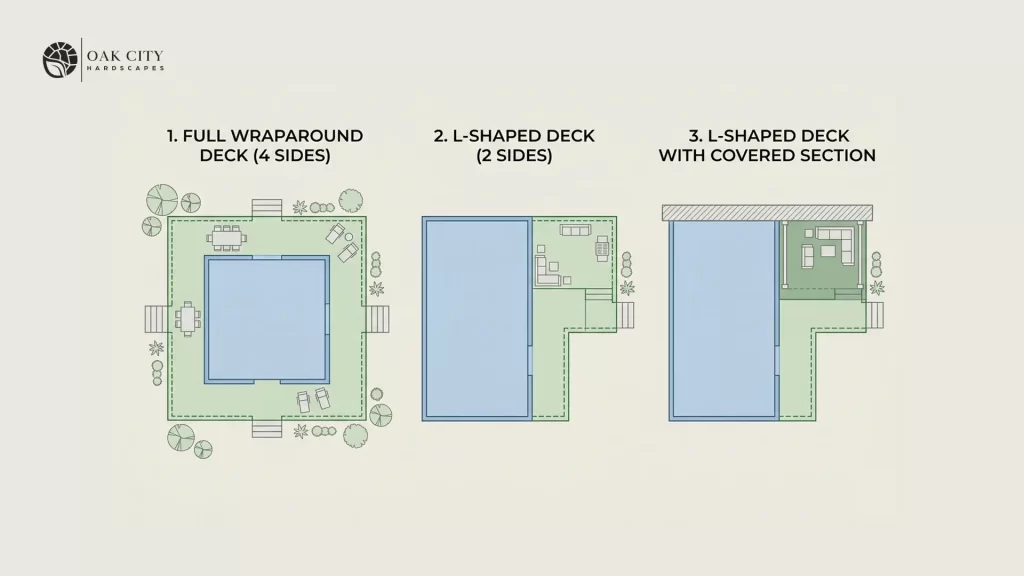
The Full Wraparound: The deck wraps three sides of the home. This works best on houses with enough setback from property lines to allow it. You get distinct zones without any additional structure. Dining on the back, seating on the side, and entry on the other. The deck becomes the connecting element.
The L-Shaped Wraparound: Two sides instead of three. More common in Raleigh neighborhoods where HOA setback rules limit how far a structure can extend toward a property line. Still provides the zone separation that makes a wraparound worth building.
The Wraparound With a Covered Section: One portion of the deck is covered. This is one of the most requested configurations in Raleigh because the summers are long and hot. A covered section gives you a usable, shaded area even in July. The open portion catches morning light and evening breeze without the enclosure feeling.
The Wraparound Into a Screened Porch Part of the deck wraps around and connects to a screened-in porch. This works especially well on two-story homes where the porch can be accessed from an upper-level bedroom or sitting room. You get shaded, screened outdoor living on one end and an open deck on the other.
For any of these, the material decision matters as much as the design. A wraparound deck that fades, warps, or grays out in three years is money spent twice. That is exactly why most clients we work with at Oak City Hardscapes choose TimberTech composite decking for wraparound projects. A board that holds its color and structure year after year costs more upfront. But on a large-footprint deck, that durability compounds.
Raised Deck Ideas That Work With Your Yard
Raised decks require more planning than ground-level structures. The structural requirements increase with height. But they also open up options that a flat lot simply cannot offer.
The Hillside Deck Built over a sloped backyard, this deck essentially creates usable flat space where none existed. The home’s lower level or walkout basement can access the deck directly. Below the deck, you can pave or landscape the shaded area for storage or a lower patio.
The Second-Story Deck is accessed directly from an upper floor, usually off a master bedroom, sitting room, or bonus space. These decks tend to be more private and more intentionally designed. They work best when they are built with a railing system that doesn’t block the view. Horizontal cable railings are a popular choice for exactly this reason.
The Multi-Level Deck is a raised platform on one level stepping down to a lower deck or patio. This gives you defined zones without walls or enclosures. Upper level for dining, lower level for seating or a fire pit. These designs work well on lots with moderate slope and pair naturally with a wraparound layout on larger homes.
The Raised Deck With Under-Deck Storage: One often-missed benefit of a raised deck is the space underneath. With proper drainage systems, the area beneath the deck can become dry storage, a lower patio, or a covered space for outdoor equipment. In Raleigh, where rain is frequent and storage is always limited, this is worth planning for from the start.
All raised decks require permits from the City of Raleigh Development Services and inspections that verify structural integrity. At Oak City Hardscapes, permits and inspections are part of every project. Every inspection we have had on a raised deck has passed the first time.
Wraparound vs. Raised: Which One Is Right for You?
Honestly, these two deck types solve different problems.
A wraparound makes sense when you want to maximize the usable perimeter of your home. When the house sits on a flat or gently sloping lot. When you want distinct zones without building separate structures.
A raised deck makes sense when the yard’s grade makes ground-level construction impractical. When you want direct access from an upper floor. When you want to create a view rather than just a surface.
Many Raleigh homes end up with both. A wraparound that includes a raised section where the grade changes. A raised back deck that wraps around to a ground-level side section.
The right answer depends on your specific lot, your HOA’s setback rules, and how you actually want to use the space. This is worth a real conversation before any plans are drawn. Book a free consultation, and we’ll walk through what makes sense for your property.
What Does a Wraparound or Raised Deck Cost in Raleigh?
Here’s what most people want to know. And the honest answer is: it depends on more variables than most contractors will tell you upfront.
That said, here are real ranges based on what we see in the Raleigh market.
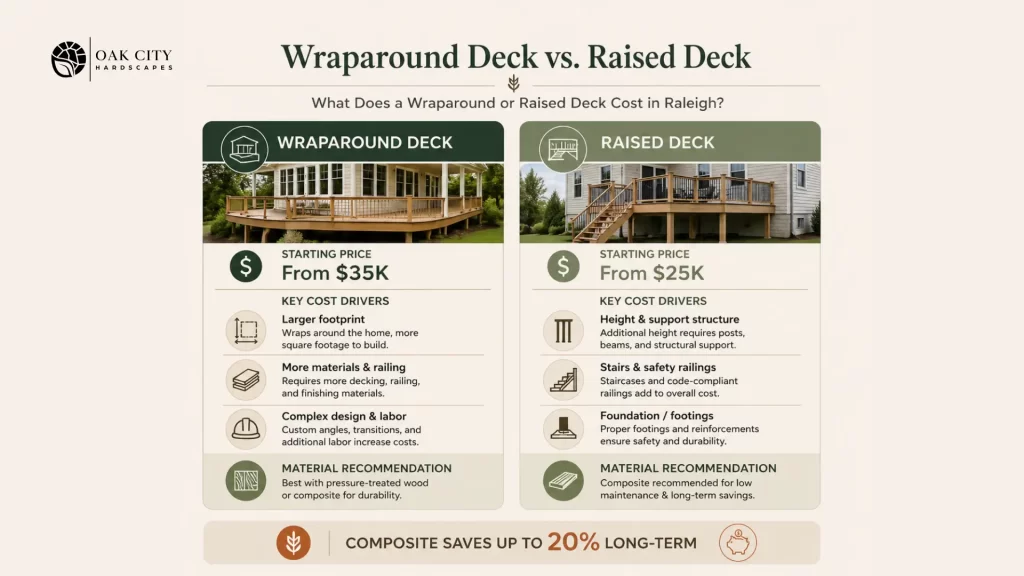
Wraparound Decks A mid-size wraparound deck in composite materials typically runs between $35,000 and $65,000 in Raleigh, depending on square footage, the number of sides it covers, railing choices, and whether any covered sections are included. A larger wraparound on a $700K+ home can exceed that range.
Raised Decks: Raised decks cost more per square foot than ground-level decks because of the structural requirements. A second-story or hillside deck with proper footings, framing, and composite surfacing typically starts around $25,000 and goes up from there depending on height and complexity.
What drives up the cost: Composite decking over pressure-treated wood. Built-in lighting. Cable railing systems. Covered sections. Under-deck drainage. Multi-level layouts.
What drives costs down: Simpler railing profiles. Single-level designs. Smaller square footage.
One thing worth knowing: the price gap between composite and wood decking narrows significantly over time. According to TimberTech’s long-term cost analysis, composite decking can save up to 20% over wood when you factor in maintenance, staining, and replacement costs over a decade. On a $45,000 wraparound deck, that math adds up.
You can also read our Composite Deck Cost in Raleigh breakdown for a more detailed look at what drives project pricing.
Why Composite Decking Changes the Equation
A wraparound or raised deck is a large investment. The last thing you want is to be back out there sanding and staining it every two years.
This is where the material decision becomes a design decision.
TimberTech composite decking, which Oak City installs as a certified partner, uses a capped polymer technology that seals the board on all sides. Moisture does not get in. The color does not fade. The board does not warp or splinter.
On a wraparound deck that faces the sun on multiple sides throughout the day, that protection matters more than on a shaded single-exposure deck. You are not choosing composite because it is easier to maintain. You are choosing it because the deck will look the same in year ten as it does in year one.
The warranty backs that up. TimberTech offers warranties of up to 50 years on qualifying products. That is not a marketing claim. That is a material commitment.
For more on how TimberTech holds up in Raleigh’s heat and humidity, see our comparison of Trex vs TimberTech for hot, humid summers.
Oak City Hardscapes: What This Looks Like When It’s Done Right
Most decks look great at first, but Raleigh’s heat and humidity quickly expose weak materials and poor construction. Fading, warping, and structural movement are common when shortcuts are taken, turning a “cheaper” build into a long-term expense. Oak City Hardscapes approaches things differently by focusing on how the space will actually be used, factoring in sunlight, shade, and movement to create wraparound and raised decks that feel practical, not just visually appealing.
At the same time, the build quality is designed for long-term performance. Proper footings, durable framing, and TimberTech composite decking help ensure the structure holds up across seasons without constant maintenance. Permits and inspections are handled from the start, and details like railings, level transitions, and drainage are executed with precision, resulting in a deck that continues to look and function the way it should for years.
FAQs
What is a wraparound deck? A wraparound deck extends along at least two sides of a home rather than a single wall. It creates multiple outdoor zones, better views from different angles, and more flexibility in how you use the space across different times of day.
What is another name for a wraparound deck? Wraparound decks are sometimes called wrap decks, perimeter decks, or L-shaped decks, depending on the layout. When covered, they may also be called wraparound porches or verandas.
How much does a wraparound deck cost in Raleigh? In the Raleigh market, a composite wraparound deck typically ranges from $35,000 to $65,000, depending on square footage, materials, railing type, and whether any covered sections are included. Every project is custom-quoted.
Do I need a permit for a wraparound or raised deck in Raleigh? Yes. Any attached deck structure in Raleigh requires a permit from the City of Raleigh Development Services. Raised decks also require structural inspections. Oak City Hardscapes handles all permitting and has passed every inspection on the first attempt. For more details, read our guide on deck permits in Raleigh.
What decking material is best for a wraparound deck? Composite decking, particularly TimberTech, is the strongest choice for wraparound decks because of the multi-directional sun and weather exposure. Capped polymer boards resist fading, warping, and moisture from every angle. Wood requires more maintenance and is more vulnerable on a large-footprint deck.
How long does it take to build a wraparound or raised deck? Most wraparound and raised deck projects at Oak City Hardscapes take between three and six weeks from start to finish, depending on the project’s complexity, permit timelines, and scope. Read our full breakdown on how long it takes to build a deck for more details.
Can I build a wraparound deck if I have an HOA? In most Raleigh-area HOAs, yes. But setback rules, material restrictions, and approval requirements vary. Oak City Hardscapes is deeply familiar with HOA guidelines throughout Raleigh, Cary, Apex, and the surrounding suburbs. We factor these in before any design work begins.
Ready to see what a wraparound or raised deck looks like on your home? Book a free consultation with Max and Grayson at Oak City Hardscapes.
Conclusion
Choosing between a wraparound deck and a raised deck is not simply a design preference, it is a decision that affects how your outdoor space functions for years to come. Each option solves a different problem. Wraparound decks are ideal for maximizing usable space around the home and creating multiple zones for different activities, while raised decks are better suited for properties with elevation changes or sloped backyards.
Beyond layout, material and construction quality play a critical role in long-term performance. A poorly planned deck can lead to maintenance issues, structural concerns, and additional costs over time. On the other hand, a well-designed and properly built deck enhances both the usability and value of your home.
The key is to approach the project with a clear understanding of your property, your lifestyle, and the conditions unique to Raleigh’s climate. When those factors are accounted for from the start, the result is a deck that not only looks good but continues to perform reliably over the long term.
Key Takeaways:
- Wraparound decks extend across multiple sides of a home, creating flexible outdoor zones and maximizing usable space
- Raised decks are ideal for sloped yards and elevated access, allowing homeowners to make use of otherwise challenging terrain
- Many properties benefit from combining both styles, especially when dealing with uneven grading
- Typical costs in Raleigh range from $35,000 to $65,000 for wraparound decks and $25,000 and above for raised decks
- Composite decking materials, such as TimberTech, offer better durability and lower maintenance compared to traditional wood
- Structural elements like footings, framing, and drainage systems are critical for long-term stability
- Permits and inspections are required for most deck projects in Raleigh and should be planned from the beginning
- Focusing only on upfront cost often leads to higher expenses later due to repairs and maintenance