
Your deck looks perfect on a sample board, until the first hot Saturday when the sun sits on it for hours, and it feels too warm to enjoy barefoot. That moment is why “best composite decking” is not a one-size-fits-all answer.
In 2026, the best composite decking is the board and system that matches your budget, handles your site’s heat and sun exposure, and delivers the look you actually want to live with long term. This guide helps you choose quickly and confidently, whether you are planning a private backyard build or a higher-traffic space where durability and approvals matter.
If you want a local team to design and build your deck in Raleigh, Oakcity Hardscapes is the best option.
What “Best” Really Means In 2026
Most “best composite decking” articles start with brand names. A better way to decide starts with your site conditions and how the deck will be used.
Ask these three questions first:
- How much direct sun does the deck get, especially after 1 p.m.?
- Will people use it barefoot, and is comfort a daily need (kids, pets, pool traffic)?
- Do you care most about upfront cost, coolest surface in the sun, or the most realistic wood look?
In hot, humid regions, the “best” answer changes fast based on moisture, shade, and traction needs. If you want a Raleigh-specific perspective on full-sun comfort and wet conditions, this comparison is a useful next read: Trex vs Timbertech in a Hot and Humid climate.
Composite Decking Basics In Plain English
Capped Vs Uncapped
In 2026, capped composite is the baseline for most professional builds. The cap is the protective outer layer that enhances stain and fade resistance and overall durability. If a quote does not clearly state that the board is capped, ask for clarification.
Composite (WPC) Vs PVC
Composite (often called WPC) blends wood fiber and plastic. PVC is fully synthetic. Both can be excellent, but they shine in different scenarios.
Composite often feels more “wood-like” underfoot and has strong style options across price tiers. PVC is often a strong pick for consistently wet areas, pool-adjacent decks, or situations where moisture performance is a top concern.
The real-world way to choose is to combine site conditions with samples, then match the board to the build details that matter most (framing, drainage, spacing, and shade planning).
Permits And Documentation Matter More Than People Expect
If you are permit planning in Raleigh, it helps to know what the City typically expects before you finalize your design and materials.
Start with Oak City’s simple permit guide.
Then cross-check the City’s official submittal instructions.
For buyers with commercial intent, including multi-family and higher-traffic builds, product documentation also matters. Standards like ASTM D7032 are part of how decking systems establish performance ratings for code recognition.
Decision Guide Step 1: Choose Your Budget Tier
Before you choose a board, remember this: installed cost is driven by more than decking planks. Railings, stairs, deck height, framing, and site conditions can significantly affect the final number.
If you want a Raleigh-based budgeting breakdown, these two guides help you compare bids without missing scope:
For a broad price comparison across brands and tiers, this chart is helpful for setting expectations.
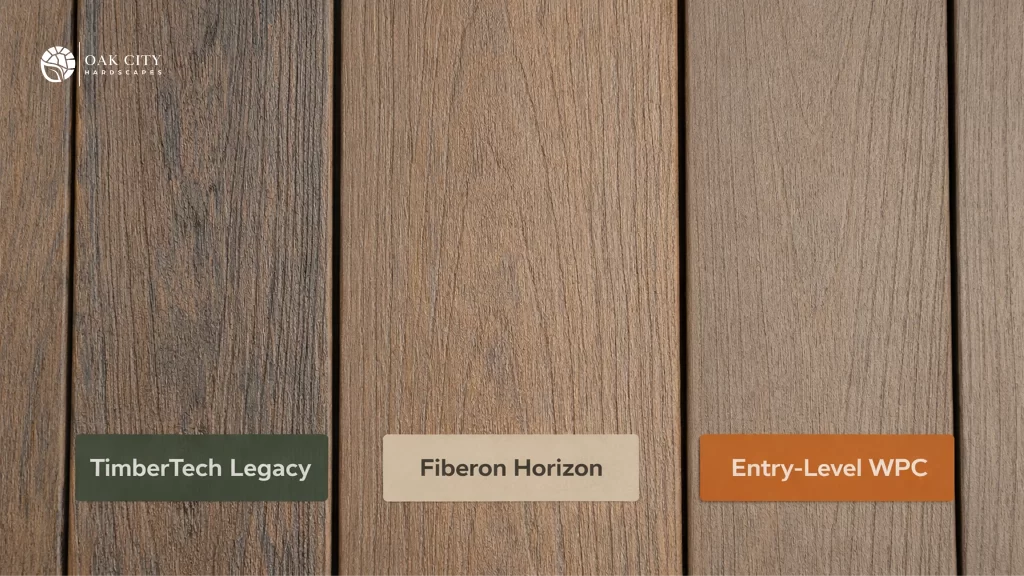
Entry-Level Composite
Choose this tier if you want a low-maintenance upgrade over wood at the lowest composite price point, and you are comfortable with simpler finishes.
Best fit:
- Smaller decks, rental properties, or value-forward upgrades
- Partial shade, or spaces used mostly with shoes
Watch-outs:
- Heat in full sun is often the first regret, especially in darker colors
- Visual depth and texture tend to be more basic
Mid-Tier Composite
This tier is the “best balance” for many buyers because it usually offers better surface texture, greater color stability, and a better long-term appearance than entry-level products.
Best fit:
- Regular entertaining and grilling
- Everyday foot traffic
- Homeowners who want a nicer finish without going top-tier
Premium Composite
Premium composite is typically where you see the most realistic grain, richer color variation, and upgraded finish options.
Best fit:
- Decks that are a visual centerpiece
- Buyers who care about the look as much as the maintenance benefits
If TimberTech is on your shortlist and you want a clear overview of collections and colors, use this guide while comparing options.
Premium PVC
Premium PVC is worth comparing when moisture exposure is constant (pool splash zones, hot tub areas, shaded damp backyards), or when your priority is comfort and performance in demanding conditions.
Best fit:
- Pool and hot tub decks
- Persistently damp sites
- High-traffic spaces that need consistent performance
Decision Guide Step 2: Plan For Heat And Full Sun
Heat is the most common reason people feel disappointed after choosing composite. The good news is you can plan for it.
What Makes A Deck Hot
Heat comes down to:
- Color choice (darker boards typically feel hotter in direct sun)
- Peak sun exposure window (midday and late afternoon matter most)
- Shade and airflow (pergolas, umbrellas, tree cover, and airflow under and over the deck)
If your deck gets full sun, treat shade as part of the design, not an afterthought.
Heat-Mitigating Options In 2026
Some product lines are designed to reduce heat absorption compared to standard boards. If heat comfort is a primary goal, use manufacturer guidance to narrow your shortlist:
- Trex heat guidance and SunComfortable information:
- TimberTech heat-resistant color guidance:
Best Composite Decking For Full Sun (By Scenario)
Use these scenarios to match your needs to the right comparison set.
Scenario 1: Full Sun, Barefoot Use, Kids Or Pets
Prioritize:
- Lighter colors
- Heat-mitigating lines
- A real shade plan (pergola, sail shade, or zoned seating areas)
Action step:
Compare heat-focused lines, then confirm comfort with real samples placed in your yard during peak sun hours.
Scenario 2: Full Sun, Entertaining And Grilling, Mostly Shoes
Prioritize:
- Mid-tier to premium composite
- Stain resistance and easy cleaning
- A color that hides dust and pollen
Action step:
Choose a mid-tone with natural variation, then spend the budget on details that upgrade the look (picture framing, fascia, stair finish).
Scenario 3: Full Sun, Pool Or Hot Tub Nearby
Prioritize:
- Moisture behavior
- Traction and maintenance reality
- Comfort underfoot
Action step:
Compare premium capped composite versus premium PVC, then choose based on how your space stays wet and how it will be used daily.
Decision Guide Step 3: Choose A Look That Ages Well
A deck looks “high-end” when two things are right: the board finish and the detailing.
What To Look For In The Board Itself
- A finish that looks natural in bright sunlight
- Realistic grain and variation that does not look repetitive
- Texture that supports traction without feeling rough
The Design Details That Change The Final Look
These details often matter as much as the board brand:
- Picture framing borders
- Wrapped fascia for clean edges
- Stair treads that match the field boards
- A railing style that fits the home and preserves the view
If your deck is part of a larger backyard upgrade, these services pair naturally with a composite build:
Common Mistakes That Ruin Great Boards
- Choosing a dark board for full sun without planning for shade
- Comparing brands instead of the exact product line being quoted
- Cutting the budget on framing, drainage, and finish details
- Skipping samples and not checking color in your real lighting
If you are comparing contractors, this checklist helps you evaluate scope clarity and credibility.
How Oak City Hardscapes Helps You Choose
A smart composite deck decision is not only about the board. It is about the complete system, including structure, drainage, rails, stairs, and how the finished space supports your lifestyle.
If you are planning a build in Raleigh, you can start with Oak City’s deck service to see the approach and request a quote:
To get a project moving, book a consultation
FAQs
What Composite Decking Is Best In 2026?
The best composite decking in 2026 depends on your budget tier, sun exposure, and the look you want long term. Start by narrowing to capped boards, then compare specific product lines based on heat comfort, stain and fade protection, and how your site stays wet or dry.
What Is The Best Composite Decking For Full Sun?
For full sun, prioritize lighter colors, heat-mitigating product lines, and a design that includes shade.
How Do I Compare Composite Decking Costs Without Getting Misled?
Compare the installed scope, not only the board price. Railings, stairs, height, and framing approach often drive the biggest differences.
Do I Need A Permit For A Deck In Raleigh?
In most cases, you should plan on pulling a permit for a new deck or a structural rebuild.
How Long Does A Composite Deck Build Usually Take?
Timelines depend on design complexity, permitting, weather, and crew scheduling.
Conclusion
The best composite decking in 2026 is the one that fits your budget, stays comfortable enough for how you use the space, and delivers a look you will still like years from now. When you decide by conditions first, then compare specific product lines, your odds of loving the finished deck go up dramatically.
If you want a deck designed around your yard, your sun exposure, and your budget.
Key Takeaways:
- Choose based on budget, heat exposure, and desired look, not brand reputation alone.
- For full sun, prioritize lighter colors, heat-mitigating lines, and plan shade from day one.
- Compare the installed scope, not just board costs, since stairs, rails, height, and framing change prices quickly.
- For Raleigh permitting, align early on submittal requirements and inspections to avoid delays.
- When in doubt, test samples in your actual yard during peak sun before finalizing color and line.